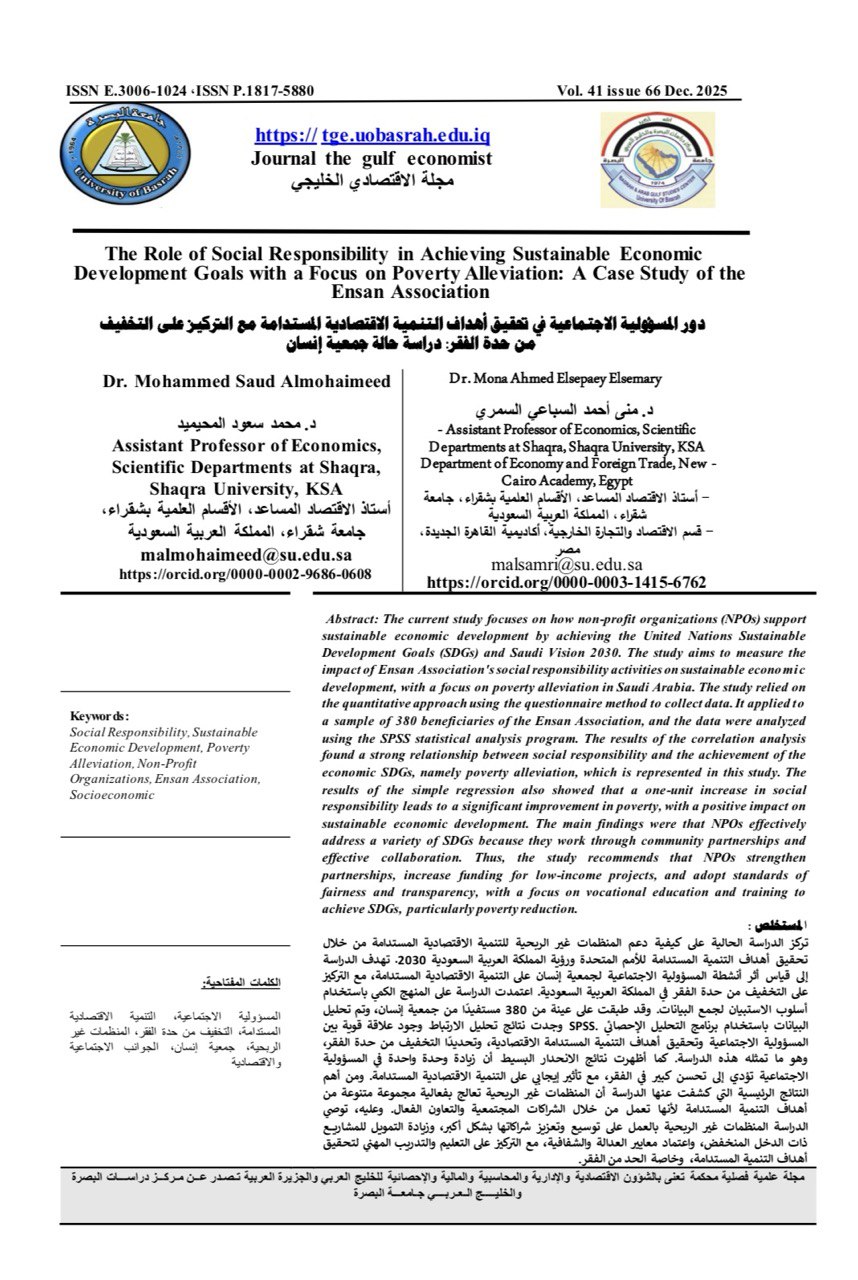
The Role of Social Responsibility in Achieving Sustainable Economic Development Goals with a Focus on Poverty Alleviation: A Case Study of the Ensan Association
Article Sidebar
Main Article Content
Abstract
Abstract: The current study focuses on how non-profit organizations (NPOs) support sustainable economic development by achieving the United Nations Sustainable Development Goals (SDGs) and Saudi Vision 2030. The study aims to measure the impact of Ensan Association's social responsibility activities on sustainable economic development, with a focus on poverty alleviation in Saudi Arabia. The study relied on the quantitative approach using the questionnaire method to collect data. It applied to a sample of 380 beneficiaries of the Ensan Association, and the data were analyzed using the SPSS statistical analysis program. The results of the correlation analysis found a strong relationship between social responsibility and the achievement of the economic SDGs, namely poverty alleviation, which is represented in this study. The results of the simple regression also showed that a one-unit increase in social responsibility leads to a significant improvement in poverty, with a positive impact on sustainable economic development. The main findings were that NPOs effectively address a variety of SDGs because they work through community partnerships and effective collaboration. Thus, the study recommends that NPOs strengthen partnerships, increase funding for low-income projects, and adopt standards of fairness and transparency, with a focus on vocational education and training to achieve SDGs, particularly poverty reduction
Article Details

This work is licensed under a Creative Commons Attribution-ShareAlike 4.0 International License.
All articles published in the journal are licensed under the Creative Commons Attribution 4.0 International License (CC BY 4.0), which permits users to reuse, distribute, and share the work, provided that appropriate credit is given to the original author and the journal.
References
Al-Adali, A. (2018). Poverty alleviation strategies in the Middle East: A Sociological Perspective. Arab Journal of Social Studies
Al-Athari, A. D., Al-Daami, H. Z. (2010). Measuring indicators of poverty in the Arab world (1st ed.). Amman, Jordan: Dar Jarir for Publishing and Distribution.
Al-Harthi, A. (2018). Poverty and the role of civil society in Saudi Arabia. Arab Journal of Social Studie
Alsani, Mona. (2023). The Role of Saudi Social Institutions through Entrepreneurship in Community Development according to Vision 2030. College Of Basic Education Research Journal, 19(1):385-404. doi: 10.33899/berj.2023.178050
Amin, S. (1989). Eurocentrism. New York, NY: Monthly Review Press.
Breunig, R., Majeed, O. (2020). Inequality, poverty and economic growth. International Economics, 161, 83-99.
Dahim, Y. M., Alshumrani, F. M., Aleidi, Y. A. (2023). An overview of the non-profit sector in the Kingdom of Saudi Arabia. 1445 AH / 2023 AD.
Das, A., Sethi, N. (2024). Cash and in-kind transfers in India: contexts, preferences and evidence. International Journal of Social Economics, 51(7), 841-856. https://doi.org/10.1108/IJSE-03-2023-0158
Drouin, J. (2016). Poverty and development: Reassessing social perspectives. Journal of Global Economics
Dulkadiroglu, H. (2019). The role of nonprofit organizations for 2030 Sustainable Development Goals. In The Role of Nonprofit Organizations for 2030 Sustainable Development Goals (pp. 1-18). ResearchGate. Retrieved from https://www.researchgate.net/publication/335222694
Elayah, M., Gaber, Q., & Fenttiman, M. (2022). From food to cash assistance: Rethinking humanitarian aid in Yemen. Journal of International Humanitarian Action, 7(1), 11. https://doi.org/10.1186/s41018-022-00119-w
Emmanuel, A. A. (2012). Poverty alleviation strategies by non-profit organisations: Benefactors’ experience in the riverine area of Ondo State, Nigeria. International Journal of Developing Societies, 1(2), 43–52. https://doi.org/ISSN 2168-1783 Print/ISSN 2168-1791 Online
Falk, A., Kosse, F., Pinger, P., Schildberg-Hörisch, H., & Deckers, T. (2021). Socioeconomic status and inequalities in children’s IQ and economic preferences. Journal of Political Economy, 129(9), 2504-2545.
Faulk, L., Kim, M., Derrick-Mills, T., Boris, E., Tomasko, L., Hakizimana, N., & Nath, L. (2021). Non-profit trends and impacts 2021. The Urban Institute.
Frank, A. G. (1967). Capitalism and underdevelopment in Latin America (Vol. 93). NYU Press.
Fuseini, M. N., Sulemana, M., Abdulai, I. A., Ibrahim, M. G., & Azure, E. (2022). Role of non-governmental organizations in poverty reduction in the global South: Evidence from World Vision Ghana, Kintampo South district. SN Social Sciences, 2(240). https://doi.org/10.1007/s43545-022-00545-y
Habibi, I. (2024). The donor’s mind: Why people give to literacy and education non-profits.
Hisham A. (2017). The Impact of Economic Growth on Poverty in the Presence of Economic Inequality in Algeria and Developing Countries during the Period 1970–2013 [Thesis, University of Abou Bekr Belkaïd]. Faculty of Economics, Commercial Sciences and Management Sciences, University of Abou Bekr Belkaïd, Tlemcen, Algeria.
Howard, R. (2023). Survival and growth of non-profit organizations: A mixed methods study on small, research focused non-profits in Washington, DC (Doctoral dissertation, Johns Hopkins University). -
Kattel, R., Kregel, J. A., Reinert, E. S. (Eds.). (2011). Ragnar Nurkse (1907-2007): Classical development economics and its relevance for today (Vol. 1). Anthem Press.
Kimberlin, C. L., & Winterstein, A. G. (2008). Validity and reliability of measurement instruments used in research. American Journal of Health-System Pharmacy, 65(23), 2276–2284. https://doi.org/10.2146/ajhp070364
King Khalid Foundation. (2025). Non-profit Sector Outlook 2025. Retrieved from https://www.kkf.org.sa/media/yicdp0k0/nonprofittrends2025.pdf
Lewis, O. (1967). The culture of poverty. Scientific American, 215(4).
Maghsoudi, A., Harpring, R., Piotrowicz, W. D., & Heaslip, G. (2023). Cash and voucher assistance along humanitarian supply chains: A Literature Review And Directions For Future Research. Disasters, 47(1), 42-77. https://doi.org/10.1111/disa.12520
Moore, D. S., McCabe, G. P., & Craig, B. A. (2014). Introduction to the Practice of Statistics (8th ed.). W.H. Freeman and Company.
Naguib, M. M., Afandy, A. H., & ELbagoury, A. A. (2022). The role of NGOs in combating poverty in developing countries: A comparative study and lessons learned. Arab Journal of Administration, 45(4), 1-18. https://doi.org/10.21608/AJA.2022.158121.1308
Omar, M. K. (1982). Critique of contemporary social thought: An analytical and critical study. Dar Al-Afak Al-Jadidah, Beirut.
Salustri, A., Viganò, F. (2017). The non-profit sector as a foundation for the interaction among the social economy, the public sector and the market, MPRA Paper 78113, University Library of Munich, Germany.
Sama, L. M., Stefanidis, A., & Horak, S. (2020). Business ethics for a global society: Howard Bowen’s legacy and the foundations of United Nations’ sustainable development goals. International Studies of Management & Organization, 50(3), 201-208. https://doi.org/10.1080/00208825.2020.1811526
Saudi Vision (2016). Saudi Vision 2030. [Online]. Available at: chrome-extension://efaidnbmnnnibpcajpcglclefindmkaj/https://www.vision2030.gov.sa/media/rc0b5oy1/saudi_vision203.pdf
Steven,K ,Thompson ,(2012). Sampling. Third. Edition, p: 59-60.
Tetteh, R. (2018). The role of non-governmental organisations (NGOs) in poverty alleviation and education, a case study in Sefwi-Wiawso Municipality (Doctoral dissertation, University of Education, Winneba.(UEW)).
The Charity Committee for Orphans Care. (2023). Beneficiary Services Regulation. Third Edition. Riyadh, Saudi Arabia. Available at: https://ensan.org.sa/
The National Center for Non-Profit Sector. (2024). Knowledge Center: History of the Non-Profit Sector. Riyadh, Saudi Arabia. Available at: https://ncnp.gov.sa/en/english#knowledge-center
Thun, P., Manh, T. (2021). Poverty Alleviation in the Aspect of Government Collaboration with NGOs. Journal of Asian Multicultural Research for Social Sciences Study. 2(2):1-5. doi: 10.47616/JAMRSSS.V2I2.128
Woller, G., & Parsons, R. (2002). Assessing the community economic impact of nongovernmental development organizations. Nonprofit and Voluntary Sector Quarterly, 31(3), 419-428