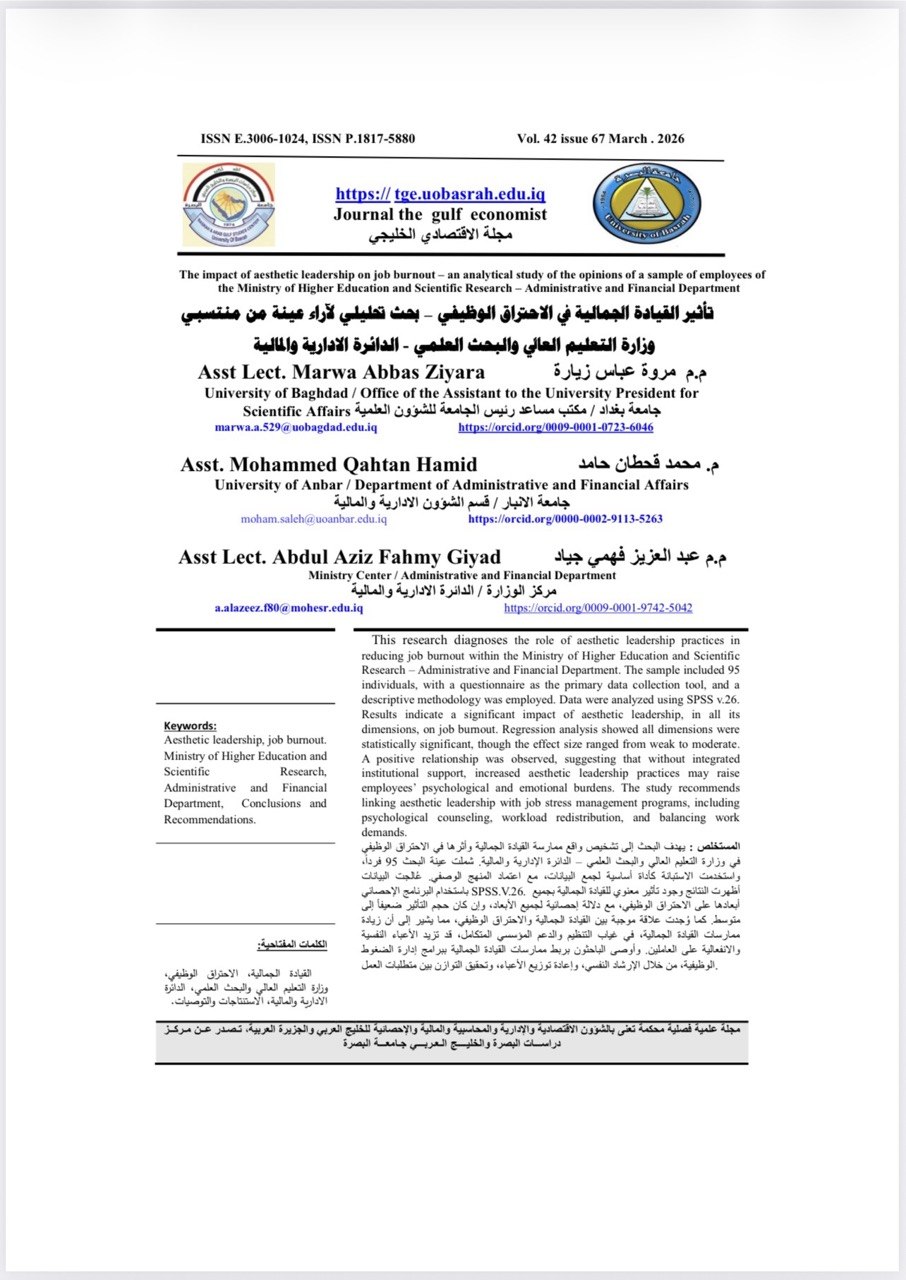
The impact of aesthetic leadership on job burnout – an analytical study of the opinions of a sample of employees of the Ministry of Higher Education and Scientific Research – Administrative and Financial Department
Article Sidebar
Main Article Content
Abstract
This research diagnoses the role of aesthetic leadership practices in reducing job burnout within the Ministry of Higher Education and Scientific Research – Administrative and Financial Department. The sample included 95 individuals, with a questionnaire as the primary data collection tool, and a descriptive methodology was employed. Data were analyzed using SPSS v.26. Results indicate a significant impact of aesthetic leadership, in all its dimensions, on job burnout. Regression analysis showed all dimensions were statistically significant, though the effect size ranged from weak to moderate. A positive relationship was observed, suggesting that without integrated institutional support, increased aesthetic leadership practices may raise employees’ psychological and emotional burdens. The study recommends linking aesthetic leadership with job stress management programs, including psychological counseling, workload redistribution, and balancing work demands.
Article Details

This work is licensed under a Creative Commons Attribution-ShareAlike 4.0 International License.
All articles published in the journal are licensed under the Creative Commons Attribution 4.0 International License (CC BY 4.0), which permits users to reuse, distribute, and share the work, provided that appropriate credit is given to the original author and the journal.
References
Abu Tabikh, Laith Shaker. (2020). Testing the relationship between aesthetic leadership behavior and organizational integrity: An applied study in the Holy Shrine of Imam Ali, Journal of the College of Education for Human Sciences, Issue (25), Twelfth Year, 145-176.
Ahmad, Rawan Muhammad Abdullah. (2023). The degree of practice of aesthetic leadership by deans of colleges and heads of departments in Jordanian private universities from the point of view of faculty members and its relationship to the effectiveness of decision-making, Jordanian Association for Educational Sciences, Jordanian Educational Journal, Volume 8, Issue 1, Supplement (2), 157-176.
Ahmed, Iman Zaghloul Ragheb and Abdel Salam, Osama Abdel Salam Ali. (2022). Developing organizational values in public secondary schools in Egypt in light of aesthetic leadership - a proposed model, Educational Administration, 13-126.
Al Muala, I., Bakir, S. A., & Al-shibly, M. (2024). Mitigating Job Burnout through Talent Management and Emotional Intelligence: Evidence from Jordanian Hospitals. Journal of System and Management Sciences, 14(7), 326-336.
Al Sabei, S. D., Al‐Rawajfah, O., AbuAlRub, R., Labrague, L. J., & Burney, I. A. (2022). Nurses' job burnout and its association with work environment, empowerment and psychological stress during COVID‐19 pandemic. International Journal of Nursing Practice, 28(5), e13077.
Alabbas, S. A. A., Jawad, M. R. B., & Sarhan, S. H. E. (2019). The Aesthetic Leadership and Its Role in Prompting the Creative Work Behaviour. Opción: Revista de Ciencias Humanas y Sociales, (22), 1057-1087.
Attari, Aref Tawfiq, and Al-Sharman, Hanan Yousef. (2017). The degree of aesthetic leadership practice in Jordanian universities from the perspective of faculty members and its relationship to their satisfaction with the work environment. Journal of the Association of Arab Universities for Higher Education Research.
Badr, S. (2021). The Effectiveness of Using the Aesthetic Approach In Improvement The Aesthetic Leadership And Motivation For Learning Among The Student-Teachers Of Philosophy And Sociology “. Journal of Scientific Research in Education, 22(9), 356-403.
Badr, Safaa Abdel Gawad Abdel Hafeez. (2021). The effectiveness of using the aesthetic approach in developing aesthetic leadership and motivation to learn among female student teachers in the Philosophy and Sociology Department, Journal of Scientific Research in Education, Ain Shams University, Issue (9), Volume (22), 356-403.
Bashandy, Ahmed Mohamed, E., & Dakrory Ali El-Said, H. (2024). Aesthetic Leadership as a Determinant of Organizational Integrity and Clinical DecisionMaking Effectiveness among Nurses. Egyptian Journal of Health Care, 15(4), 999-1012.
Captain, Khalid Khairallah Muhammad, Fattah, Noura Aziz, and Khattab, Aws Muhammad Ali. (2025). The Impact of Aesthetic Leadership Dimensions on Achieving Organizational Effectiveness: An Exploratory Study of the Opinions of a Sample of Teaching Staff in Private Schools in Nineveh Governorate. Khazayin of Economic and Administrative Sciences. Publisher: College of Administration and Economic Sciences, University of Diyala, pp. 95-107.
Chen, W., Zhou, S., Zheng, W., & Wu, S. (2022). Investigating the relationship between job burnout and job satisfaction among Chinese generalist teachers in rural primary schools: A serial mediation model. International Journal of Environmental Research and Public Health, 19(21), 14427.
Coban, H. S. M.(2016). A research on the relationship between organizational silence and burnout. European Scientific Journal, 145-154.
Dangmei, J., & Singh, A. (2017). How aesthetic leadership style might relate to employee morale at workplace? An analytical study. Asia Pacific Journal of Research, 1.
Darwazeh, S. S. (2019). Effect of the Environment of the Internal Work on the Extent of the Occupational Exhaustion: an Applied Study on Some Departments of the Public Sector. British Journal of Humanities and Social Sciences, 23(1).
Farasat, M., Gull, M., & Hassan, S. (2024). Unveiling the influence of Aesthetic Leadership: Enhancing Employee Self-Efficacy through Job-Capabilities Matching and the Pygmalion Effect. Remittances Review, 9(1), 3317-3337
Gahlot, S., & Bathla, A. (2021). Aesthetic leadership: A review. Focus, 23(4), 39.
Gün, İ., Balsak, H., & Ayhan, F. (2025). Mediating Effect of Job Burnout on the Relationship Between Organisational Support and Quiet Quitting in Nurses. Journal of Advanced Nursing, 81(8), 4644-4652.
Güven, E., & Polat, S. (2016). Aesthetic Leadership Perceptions of High School Students Regarding Their Teachers. Journal of Education and Training Studies, 4(11), 109-118.
Hansen, H., Ropo, A., & Sauer, E. (2007). Aesthetic leadership. The Leadership Quarterly, 18(6), 544-560.
Hita, Safaa Al-Islam and Al-Amoudi, Shahrazad. (2025). The role of quality of work life in reducing the phenomenon of job burnout among employees, a case study of the Setram Foundation - Ouargla, Master's thesis in Management Sciences, Faculty of Economic, Commercial and Management Sciences, Kasdi Merbah University of Ouargla, Algeria.
Jalal, Abubakr Ahmed Siddiq and Abdel Rahim, Muhammad Abbas Muhammad. (2015). A proposed model for developing the functions of Egyptian universities in light of the dimensions of aesthetic leadership. Arab Studies in Education and Psychology, 57(2), 297-398.
Lubbadeh, T. (2020). Job burnout: A general literature review. International Review of Management and Marketing, 10(3), 7.
Malik, A. R., & Singh, P. (2020). The role of employee attributions in burnout of “talented” employees. Personnel Review, 49(1), 19-42.
Maslach, C. and Leiter, M.P., 2016. Understanding the burnout experience: recent research and its implications for psychiatry. World Psychiatry, 15(2), pp.103-111.
Mitias, M. H. (2025). The Beautiful in Fine Art. Journal of Comparative Literature and Aesthetics, 48(4), 12-27.
Monge Moreno, J. T. (2025). Aesthetic Leadership in Nursing: A Theoretical Proposal for Rehumanizing Care Delivery. Nursing Inquiry, 32(3), e70034.
Nasr, Faraj Ali Faraj and Al-Qubbi, Tayeb Muhammad. (2023). Job burnout and its relationship to job performance, a case study on the Faculty of Economics at Sirte University, Libya, Journal of Economic Studies, Faculty of Economics, Sirte University, Volume 6, Issue 1, 185-209.
Polat, S., & Öztoprak-Kavak, Z. (2011). Aesthetic leadership (AL): Development and implementation of aesthetic leadership scale (ALS) of the school directors. Educational Research and Reviews, 6(1), 50.
Qaoud, Marwa Salah, Abdel Latif, Maysa Fathi, and Hussein, Islam El-Sayed. (2022). The impact of aggressive behavior on job burnout among employees in tourism and hotel establishments, International Journal of Heritage, Tourism and Hospitality, Volume (16), Issue (2), 21-44.
Reda, Sakhri Mohamed. (2025). The effect of job burnout on the job performance of employees in the organization, a case study in the company - SAMHA Home Appliance - Setif, Master's thesis in Management Sciences, Faculty of Economic, Commercial and Management Sciences, University of Setif, Algeria.
Sağlam, A. S. (2011). Akademik Personelin sosyo-demografik özelliklerinin tükenmişlik düzeyleri ile ilişkisi/Relatıonshıp of socıo-demographıc characterıstıcs of academıcıans wıth theır burnout levels. Mustafa Kemal Üniversitesi Sosyal Bilimler Enstitüsü Dergisi, 8(15), 407-420.
Schroeder, J. E. (2008). Aesthetic Leadership. Key Concepts In Leadership Studies, Antonio Marturano, Jonathan Gosling, Eds, 5-7.
Strati, A. (2010). Aesthetic understanding of work and organizational life: Approaches and research developments. Sociology Compass, 4(10), 880-893.
Stufano, A., Awoonor-Williams, J. K., & Vimercati, L. Editorial: Factors and health outcomes of job burnout. Front Public Health 2022; 10: 1023462.
Tang, Y., Wang, Y., Zhou, H., Wang, J., Zhang, R., & Lu, Q. (2023). The relationship between psychiatric nurses’ perceived organizational support and job burnout: Mediating role of psychological capital. Frontiers in psychology, 14, 1099687.
Yuliana, L., Azmy, A., Nurwardana, J. R., Perkasa, D. H., Alfian, R., Aisah, N., & Putra, M. F. R. (2025). The Impact of Work Stress and Job Burnout on Turnover Intention among Indonesia-China Integrated Industrial Employees. Journal of Applied Business Administration, 9(1), 1-12.
Ziada, Rania Mohamed Mahmoud. (2020). "The role of job burnout in affecting job satisfaction, a case study on administrators in Asir Central Hospital in Abha City," Egyptian Journal of Business Studies, Mansoura University, Volume (44), Issue (3). 1-32.