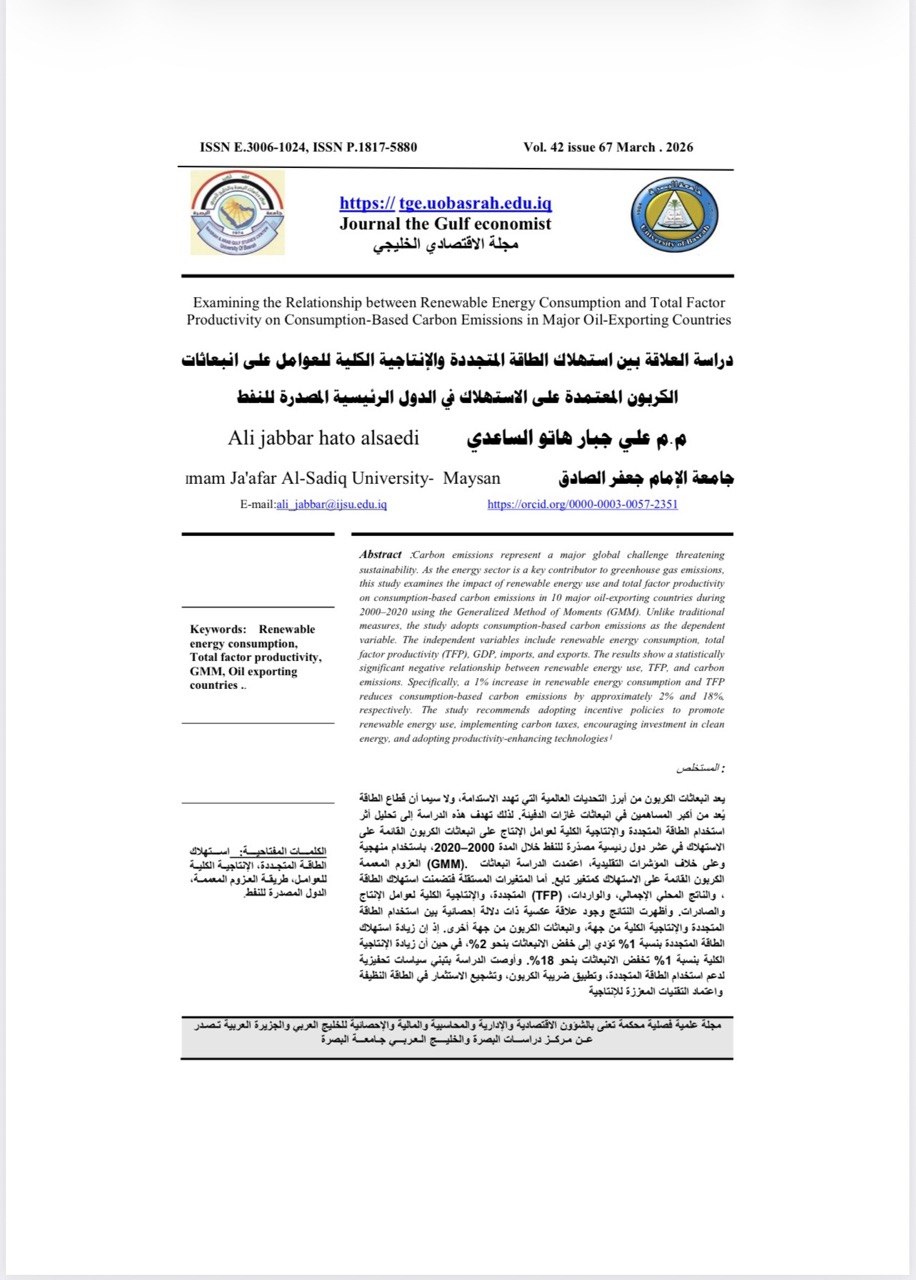
Examining the Relationship between Renewable Energy Consumption and Total Factor Productivity on Consumption-Based Carbon Emissions in Major Oil-Exporting Countries
Article Sidebar
Main Article Content
Abstract
Carbon emissions represent a major global challenge threatening sustainability. As the energy sector is a key contributor to greenhouse gas emissions, this study examines the impact of renewable energy use and total factor productivity on consumption-based carbon emissions in 10 major oil-exporting countries during 2000–2020 using the Generalized Method of Moments (GMM). Unlike traditional measures, the study adopts consumption-based carbon emissions as the dependent variable. The independent variables include renewable energy consumption, total factor productivity (TFP), GDP, imports, and exports. The results show a statistically significant negative relationship between renewable energy use, TFP, and carbon emissions. Specifically, a 1% increase in renewable energy consumption and TFP reduces consumption-based carbon emissions by approximately 2% and 18%, respectively. The study recommends adopting incentive policies to promote renewable energy use, implementing carbon taxes, encouraging investment in clean energy, and adopting productivity-enhancing technologiesا
Article Details

This work is licensed under a Creative Commons Attribution-ShareAlike 4.0 International License.
All articles published in the journal are licensed under the Creative Commons Attribution 4.0 International License (CC BY 4.0), which permits users to reuse, distribute, and share the work, provided that appropriate credit is given to the original author and the journal.
References
Amirnaba, A. (2023). The impact of economic growth, non-renewable energy consumption, and urbanization on carbon dioxide emissions in OPEC member countries. Iranian Journal of Energy Economics, 12(48), 11–30.
Arifian, M. R., Farjidi Dezji, S., & Ghasemi, S. (2020). Examining the role of renewable energy, non-renewable energy, and economic growth on carbon emissions in OECD countries. Modern Economics and Trade, 15(3), 109–137.
Chen, Y., & Li, J. (2020). Energy consumption, economic growth, and carbon emissions: Evidence from natural gas exporters. Energy Policy, 137, 111098. https://doi.org/10.1016/j.enpol.2020.111098
Davis, S. J., & Caldeira, K. (2010). Consumption-based accounting of CO2 emissions. Proceedings of the National Academy of Sciences, 107(2), 5687–5692. https://doi.org/10.1073/pnas.0906974107
Färe, R., Grosskopf, S., & Margaritis, D. (1994). Productivity growth, technical progress, and efficiency change in industrialized countries. American Economic Review, 84(1), 66–83.
Hasanov, F. J., Liddle, B., & Mikayilov, J. I. (2018). The impact of international trade on CO2 emissions in oil exporting countries: Territory vs. consumption emissions accounting. Energy Economics, 74, 343–350. https://doi.org/10.1016/j.eneco.2018.06.004
Hasanov, F. J., Shia, R., Papadas, D., & Kostakis, I. (2024a). The consumption-based carbon emissions effects of renewable energy and total factor productivity: The evidence from natural gas exporters. Energy Reports, 12, 5974–5989. https://doi.org/10.1016/j.egyr.2024.11.054
Hasanov, F. J., Mukhtarov, S., Suleymanov, E., & Shannak, S. (2024b). The role of renewable energy and total factor productivity in reducing carbon emissions: A case of top-ranked nations in the renewable energy country attractiveness index. Journal of Environmental Management, 361, 121220. https://doi.org/10.1016/j.jenvman.2024.121220
Jiang, C., & Ma, X. (2019). The impact of financial development on carbon emissions: A global perspective. Sustainability, 11(19), 5241. https://doi.org/10.3390/su11195241
Kargar Deh Bidi, N., & Bakhshoudeh, M. (2019). Comparing the impact of fossil and renewable energy on carbon dioxide emissions in OPEC member countries and Asian countries without oil reserves. Environmental Studies, 10(19), 313–326.
Masoudi, N., Dahmarde, N., & Esfandiari, M. (2020). Examining the impact of renewable energy, technological innovations, and economic growth on carbon dioxide emissions. Economic Growth and Development Studies, 10(40), 35–54.
Mohammadi, N., Sahabi, H., & Sadeghi Sagdel, H. (2023). Examining the impact of economic complexity and renewable energy consumption on environmental pollution in developing countries. Economic Research (Sustainable Growth and Development), 23(4), 1–24.
Mukhtarov, S. (2024). Do renewable energy and total factor productivity eliminate CO2 emissions in Turkey? Environmental Economics and Policy Studies, 26, 307–324. https://doi.org/10.1007/s10018-023-00377-x
Mukhtarov, S., Aliyev, F., Aliyev, J., & Ajayi, R. (2023). Renewable energy consumption and carbon emissions: Evidence from an oil-rich economy. Sustainability, 15(1), 134. https://doi.org/10.3390/su15010134
Peters, G. P., Minx, J. C., Weber, C. L., & Edenhofer, O. (2011). Growth in emission transfers via international trade from 1990 to 2008. Proceedings of the National Academy of Sciences, 108(21), 8903–8908. https://doi.org/10.1073/pnas.1006388108
Rahbar, F., Barkhori, S., & Qarabaghi Donyadari, P. (2019). Examining the effect of energy productivity shocks on carbon dioxide emissions in major sectors of the Iranian economy: A Panel-VAR approach. Environmental Economics and Natural Resources, 3(6), 29–53.
Shafiei, S., & Salim, R. A. (2014). Non-renewable and renewable energy consumption and CO2 emissions in OECD countries: A comparative analysis. Energy Policy, 66, 547–556. https://doi.org/10.1016/j.enpol.2013.10.064
Vasilenko, A., Ivanov, M., & Antonov, V. (2017). Renewable energy consumption and carbon emissions: Evidence from European countries. Renewable Energy, 101, 187–193.
Wiebe, K. S., & Yamano, N. (2016). Estimating CO2 emissions embodied in final demand and trade using the OECD ICIO 2015: Methodology and results. OECD Science, Technology and Industry Working Papers, No. 2016/05. OECD Publishing, Paris. https://doi.org/10.1787/5jlrcm216xkl
Zabihi, S. M., Akbari, F., & Salehnia, N. (2023). The effect of renewable energy consumption on carbon emission reduction (with an emphasis on wind and solar energy). Energy Economics Modeling, 1(1).