The Role of Comprehensive Banking Risk Management in Realizing the Hidden Value of Banks within the framework of Strategic Sensitivity -(Case Study in the branches of the International Development Bank in the Middle Euphrates region)
Article Sidebar
Main Article Content
Abstract
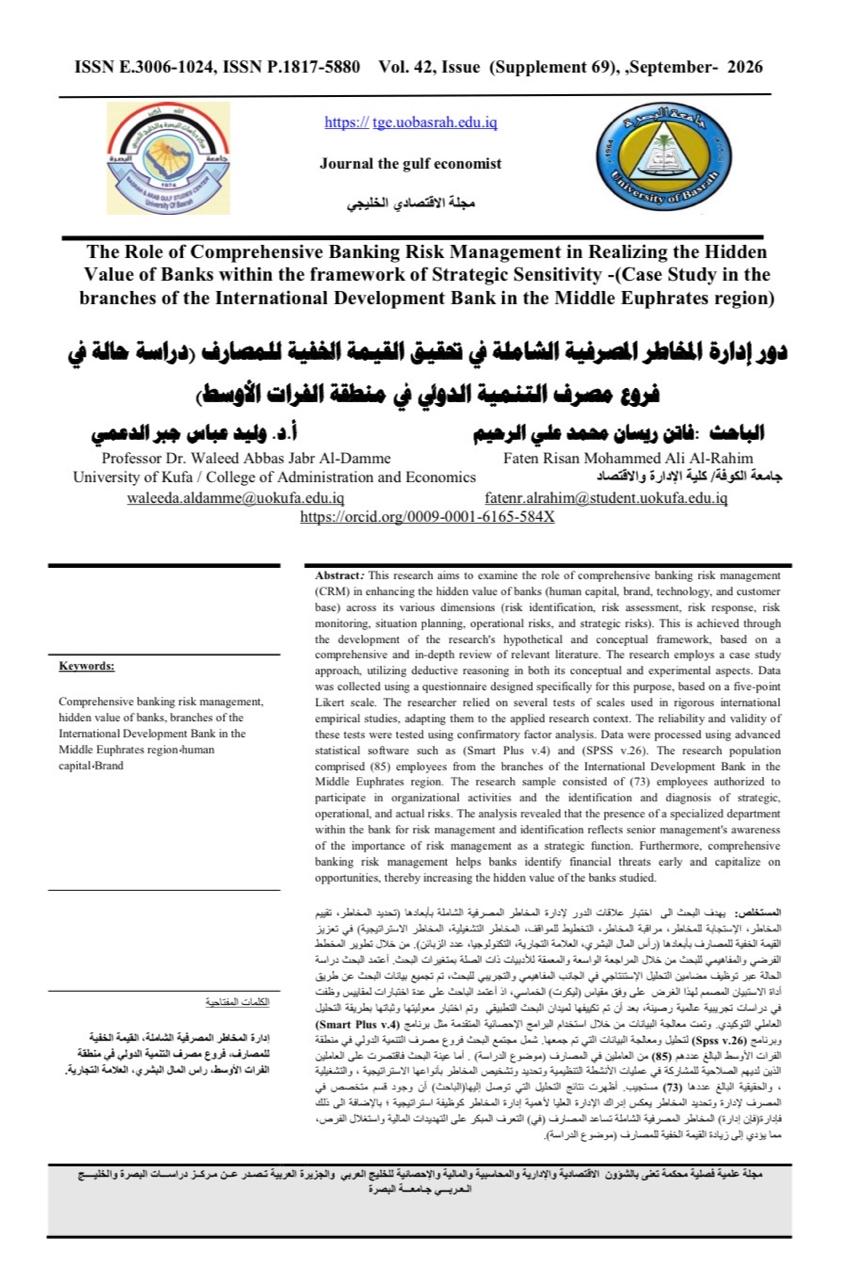
Abstract :This research aims to examine the role of comprehensive banking risk management (CRM) in enhancing the hidden value of banks (human capital, brand, technology, and customer base) across its various dimensions (risk identification, risk assessment, risk response, risk monitoring, situation planning, operational risks, and strategic risks). This is achieved through the development of the research's hypothetical and conceptual framework, based on a comprehensive and in-depth review of relevant literature. The research employs a case study approach, utilizing deductive reasoning in both its conceptual and experimental aspects. Data was collected using a questionnaire designed specifically for this purpose, based on a five-point Likert scale. The researcher relied on several tests of scales used in rigorous international empirical studies, adapting them to the applied research context. The reliability and validity of these tests were tested using confirmatory factor analysis. Data were processed using advanced statistical software such as (Smart Plus v.4) and (SPSS v.26). The research population comprised (85) employees from the branches of the International Development Bank in the Middle Euphrates region. The research sample consisted of (73) employees authorized to participate in organizational activities and the identification and diagnosis of strategic, operational, and actual risks. The analysis revealed that the presence of a specialized department within the bank for risk management and identification reflects senior management's awareness of the importance of risk management as a strategic function. Furthermore, comprehensive banking risk management helps banks identify financial threats early and capitalize on opportunities, thereby increasing the hidden value of the banks studied.
Article Details

This work is licensed under a Creative Commons Attribution-ShareAlike 4.0 International License.
References
References:
Al-Hamdi, F. J. M. A. H. (2024). Risk management and its impact on bank sustainability: A strategic perspective – Analytical study of a sample of commercial banks in the Iraq Stock Market (2005–2022) [Master’s thesis, University of Karbala]. College of Administration and Economics.
Jamil, A. K. A. (2015). Bank marketing (1st ed.). Dar Al-Janadriyah for Publishing and Distribution.
Acosta‑Prado, J. C., & Tafur‑Mendoza, A. A. (2023). Influence of information and communication technologies on customer satisfaction and increase in the number of customers. VINE Journal of Information and Knowledge Management Systems, 53(3), 377–386.
Adeniran, I. A., Abhulimen, A. O., Obiki-Osafiele, A. N., Osundare, O. S., Agu, E. E., & Efunniyi, C. P. (2024). Strategic risk management in financial institutions: Ensuring robust regulatory compliance. Finance & Accounting Research Journal, 6(8), 1582-1596. https://doi.org/10.51594/farj.v6i8.1508
Adhista Setyarini, Ziko Hamdi, & Mohd Syahrin. (2025). Evaluation Of Risk Management Strategies In Profit Optimization In The Banking Sector. International Journal Of Financial Economics (IJEFE), 2(5), 380-394.
Ahmed Haji, A. (2016). Trend of hidden values and use of intellectual capital information: Evidence from Malaysia. Accounting Research Journal, 29(1), 81-105.
Alawa, A. (2025). Analysis of determinants of risk management quality and its impact on the value of Algerian commercial banks [Doctoral dissertation, Faculty of Economic Sciences, Commercial Sciences, and Management Sciences, University of Algiers 3]. University of Algiers 3. https://dspace.univ-alger3.dz/jspui/handle/123456789/10311
Al-Husseini, S. H. K. (2025). The mediating role of cybersecurity in the relationship between value-based risk management and banks’ inertia [Master’s thesis, University of Kufa, College of Administration and Economics, Department of Financial and Banking Sciences]. Iraq: Ministry of Higher Education and Scientific Research.
Allan, N., & Beer, L. (2006). Strategic risk: It’s all in your head (Working Paper). Faculty and Institute of Actuaries. https://www.researchgate.net/publication/251746563_Strategic_Risk_It%27s_all_in_your_head
Awosina, O. O. (2020). The study of enterprise risk management, its benefits and principles and how it can help an organisation to achieve growth and profitability (Unpublished doctoral dissertation). Selinus University.
Bavdaž, M., Caloghirou, Y., Dimitrić, M., & Protogerou, A. (2022). Intangible assets and their impact on economic performance. Economic and Business Review, 24(3), 143-151.
Dalil, A. M. O., & Shabo, I. M. A. (2021). The importance of risk management efficiency in evaluating financial and administrative performance in commercial banks: Case study of Al-Muzari’ Commercial Bank. Arab Journal for Scientific Publishing, (35), 136. https://www.ajsp.net
Derah, B. H. (2020). A critical analysis of how enterprise risk management impacts organisational performance: A study of the oil and gas industry in Qatar [Unpublished doctoral dissertation]. Cardiff Metropolitan University.
Dhunoon, A. A., & Talalwah, M. A. (2020). Professional compliance with the internal control framework for risk management (ERM) and its role in confronting financial and banking crises: An analytical study. Tikrit Journal of Administrative and Economic Sciences, 16(Special Issue, Part 1), 161–176.
Diefenbach, T. (2004). The conceptualization and management of intangible assets: high expectations, low outcomes. Journal of Business Ethics, 52(4), 357–374. https://doi.org/10.1007/s10551-004-1421-6
e Silva, C. A. B. F. (2009). The Hidden Value Behind Capital Structure Decisions (Master's thesis, Universidade NOVA de Lisboa (Portugal)).
Fischer, R. J., Halibozek, E. P., & Walters, D. C. (2018). Contingency planning emergency response and safety. Introduction to security, 249.
Hadi, Q. A., & Athab, G. M. (2023). Building banks’ brand through social media marketing. Journal of Kufa Studies, Special Issue, 758–793. https://doi.org/10.36322/jksc.176(G).20140
Jaddi, H. (2014). The impact of risk management on financial performance of economic institutions: Case study of a sample of Algerian institutions [Doctoral dissertation, University of Mohamed Khider – Biskra, Algeria].
Kenett, R. S., & Raanan, Y. (Eds.). (2011). Operational Risk Management: a practical approach to intelligent data analysis. John Wiley & Sons.
Kongka, P. (2012). Exploring the effects of voluntary disclosures on hidden value: an analysis of Australian and Thai listed companies (Doctoral dissertation, The University of Newcastle Australia).
Krechowicz, M. (2020). Comprehensive risk management in horizontal directional drilling projects. Journal of Management in Engineering, 36(3). https://doi.org/10.1061/(ASCE)ME.1943-5479.0000781
Liu, X. (2019). The role of enterprise risk management in sustainable decision-making: A cross-cultural comparison. Sustainability, 11(10), 2939. https://doi.org/10.3390/su11102939
Maulana, A., Dwita, M., Fitriyani, M., Sunaryo, D., & Adiyanto, Y. (2024). Risk management as a determinant of Indonesian banking financial performance: A systematic literature approach. Indo-Fintech Intellectuals Journal of Economics and Business, 4(5), 2523–2537. https://doi.org/10.54373/ifijeb.v4i5.2120
Mohammed, H. J., Hasan, S. A., & Naji, A. H. (2024). INTANGIBLE ASSETS AND THEIR IMPACT ON THE BALANCE SHEET OF IRAQI BANKS. The American Journal of Management and Economics Innovations, 6(02), 44-55.
Mpaata, E., Koskei, N., & Saina, E. (2020). Financial literacy and saving behavior among micro and small enterprise owners in Kampala, Uganda: The moderating role of social influence. Journal of Economics, Finance and Accounting Studies, 2(1), 22-34.
Najjar, H. (2014). Bank risk management according to Basel agreements: A study of the reality of public commercial banks in Algeria [Unpublished doctoral dissertation, University of Ferhat Abbas – Setif, Algeria].
Natalia, F., & Prasetyo, A. H. (2022). Rancangan Implementasi Manajemen Risiko Operasional Pada Sekolah Menengah Kejuruan Pariwisata Di Jakarta 2023–2024. Jurnalku, 2(4), 463–481. https://doi.org/10.54957/jurnalku.v2i4.294
Navin Kumar. (2024). Risk Management Practices in Personal Finance Planning: Comprehensive Risk Management in Personal Finance. SSRN. https://ssrn.com/abstract=4844836
O'Reilly III, C. A., & Pfeffer, J. (2000). Unlocking the hidden value in organizations. Employment Relations Today, 27(2), 63-80.
Pavkovic, A., & Marosevic, K. (2014). Human capital in financial institutions. Economic and Social Development: Book of Proceedings, 403.
Petković, Đ., Radjenović, T., & Kasas, A. (2020). Intangible assets as a source of competitive advantage in the knowledge economy. Economic Themes, 58(1), 1–22. https://doi.org/10.2478/ethemes‑2020‑0001
Putri, L. P. (2018). Penerapan Manajemen Risiko Strategi pada Ijarah Multijasa (Studi Kasus di Bank Syariah Kotabumi Kantor Cabang Bandar Lampung) (Doctoral dissertation, IAIN Metro).
Rochette, M. (2009). From risk management to enterprise risk management. Journal of Risk Management in Financial Institutions, 2(4), 394–408.
Smith, A. (2003). The wealth of nations (Bantam Classics ed.). Bantam Books. (Original work published 1776)
Tariq, S. D. M., & Hala. (2022). The impact of investment in human capital on the optimal utilization of natural resources: An applied study on Egypt 2000–2018. Journal of Political and Economic Studies, 2(3), 166–206.
Trzaska, R., Sus, A., Wilczyński, M., & Bekisz, A. (2025). Strategic risks in Industry 4.0 – Scalability perspective. Humanities and Social Sciences, 32(2), 179–198.
Tursoy, T. (2018). Risk management process in banking industry. Munich Personal RePEc Archive (MPRA Paper No. 86427).
Vallejo-Alonso, B., Rodriguez-Castellanos, A., & Arregui-Ayastuy, G. (Eds.). (2010). Identifying, Measuring, and Valuing Knowledge-Based Intangible Assets: New Perspectives: New Perspectives. IGI Global.
Van Gestel, T., & Baesens, B. (2009). Credit Risk Management: Basic Concepts: financial risk components, rating analysis, models, economic and regulatory capital. Oxford University Press.
Yaylali, P., & Safakli, O. V. (2015). Risk management in the banking sector: Case of TRNC. International Journal of Academic Research in Economics and Management Sciences, 4(3), 17–31.
Zhang, Y., & Fan, Z. P. (2016). Selecting risk response strategies considering project risk interdependence. International Journal of Project Management, 34(5), 819–830.