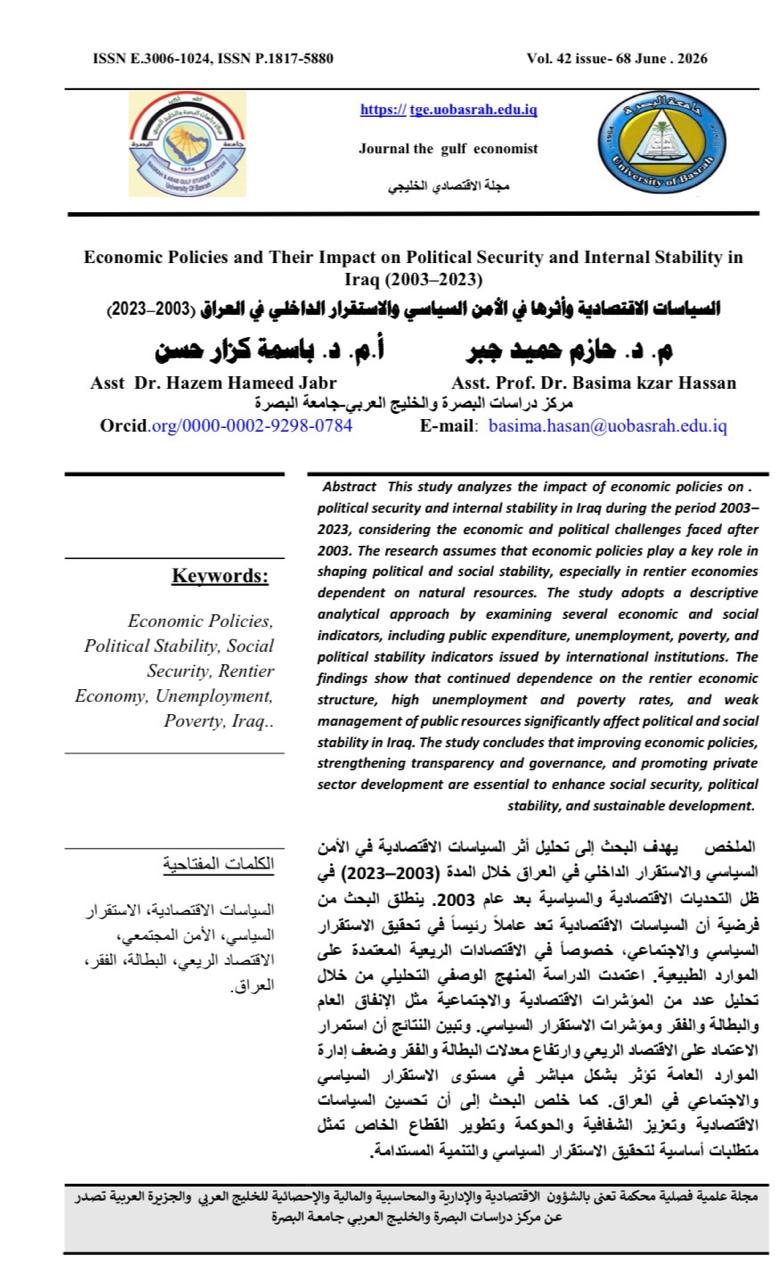
Economic Policies and Their Impact on Political Security and Internal Stability in Iraq (2003–2023
Article Sidebar
Main Article Content
Abstract
. Abstract This study analyzes the impact of economic policies on political security and internal stability in Iraq during the period 2003–2023, considering the economic and political challenges faced after 2003. The research assumes that economic policies play a key role in shaping political and social stability, especially in rentier economies dependent on natural resources. The study adopts a descriptive analytical approach by examining several economic and social indicators, including public expenditure, unemployment, poverty, and political stability indicators issued by international institutions. The findings show that continued dependence on the rentier economic structure, high unemployment and poverty rates, and weak management of public resources significantly affect political and social stability in Iraq. The study concludes that improving economic policies, strengthening transparency and governance, and promoting private sector development are essential to enhance social security, political stability, and sustainable development.
Article Details

This work is licensed under a Creative Commons Attribution-ShareAlike 4.0 International License.
References
References:
Auty, R. (2001). Resource Abundance and Economic Development. Oxford University Press.
Beblawi, H., & Luciani, G. (1987). The Rentier State. London: Croom Helm.
Blanchard, O., & Johnson, D. (2017). Macroeconomics. Pearson Education.
Caporaso, J., & Levine, D. (1992). Theories of Political Economy. Cambridge University Press.
Davies, J. (1962). Toward a Theory of Revolution. American Sociological Review.
Friedman, M. (2002). Capitalism and Freedom. University of Chicago Press.
Gurr, T. (1970). Why Men Rebel. Princeton University Press.
Huntington, S. (1968). Political Order in Changing Societies. Yale University Press.
International Labour Organization (ILO). (2021). World Employment and Social Outlook. Geneva.
International Monetary Fund (IMF). (2022). Iraq Country Reports.
متاح على: https://www.imf.org
Karl, T. (1997). The Paradox of Plenty: Oil Booms and Petro-States. University of California Press.
Kaufmann, D., Kraay, A., & Mastruzzi, M. (2011). Worldwide Governance Indicators. World Bank.
Luciani, G. (1990). The Arab State. University of California Press.
Mahdavy, H. (1970). The Patterns and Problems of Economic Development in Rentier States. In: Studies in Economic History of the Middle East.
Mankiw, N. (2019). Principles of Economics. Cengage Learning.
Marx, K. (1990). Capital: A Critique of Political Economy. Penguin Books.
Musgrave, R., & Musgrave, P. (1989). Public Finance in Theory and Practice. McGraw-Hill.
Rose-Ackerman, S., & Palifka, B. (2016). Corruption and Government. Cambridge University Press.
Ross, M. (2001). Does Oil Hinder Democracy? World Politics.
Ross, M. (2012). The Oil Curse: How Petroleum Wealth Shapes the Development of Nations. Princeton University Press.
Runciman, W. (1966). Relative Deprivation and Social Justice. University of California Press.
Samuelson, P., & Nordhaus, W. (2010). Economics. McGraw-Hill.
Stiglitz, J., & Rosengard, J. (2015). Economics of the Public Sector. W.W. Norton.
Todaro, M., & Smith, S. (2015). Economic Development. Pearson Education.
Walker, I., & Pettigrew, T. (1984). Relative Deprivation Theory: An Overview and Conceptual Critique. British Journal of Social Psychology.
Central Bank of Iraq. Annual Statistical Bulletin. Baghdad: Central Bank of Iraq, various years.
International Monetary Fund (IMF). Iraq Country Reports. Available at: https://www.imf.org
Iraqi Ministry of Finance. General Budget Data of the Republic of Iraq. Baghdad: Ministry of Finance, various years.
Iraqi Ministry of Planning – Central Statistical Organization. Labour Market, Unemployment and Poverty Reports in Iraq. Baghdad: Ministry of Planning, various years.
Transparency International. Corruption Perceptions Index (CPI). Available at: https://www.transparency.org
World Bank. World Development Indicators (WDI). Available at: https://data.worldbank.org
World Bank. Worldwide Governance Indicators (WGI). Available at: https://info.worldbank.org/governance/wgi