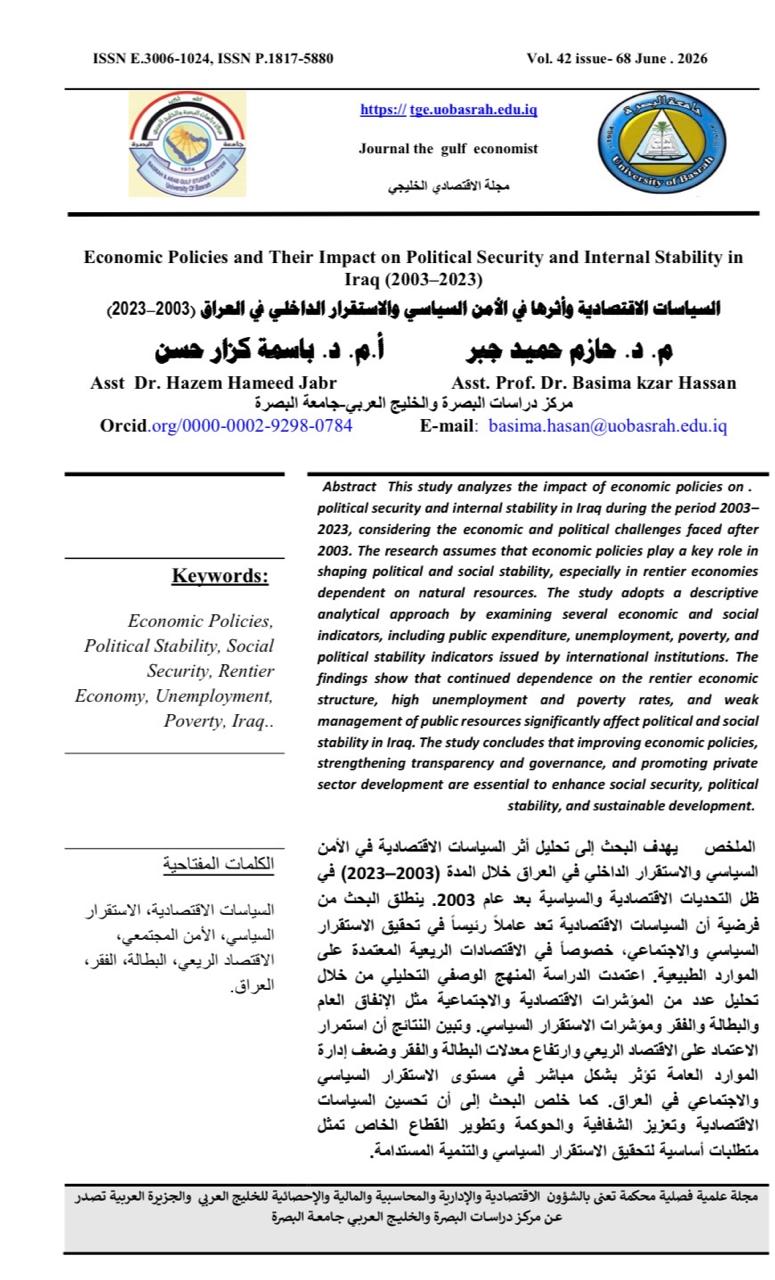
السياسات الاقتصادية وأثرها في الأمن السياسي والاستقرار الداخلي في العراق (2003–2023)
الشريط الجانبي للمقالة
محتوى المقالة الرئيسي
الملخص
الملخص يهدف البحث إلى تحليل أثر السياسات الاقتصادية في الأمن السياسي والاستقرار الداخلي في العراق خلال المدة (2003–2023) في ظل التحديات الاقتصادية والسياسية بعد عام 2003. ينطلق البحث من فرضية أن السياسات الاقتصادية تعد عاملاً رئيساً في تحقيق الاستقرار السياسي والاجتماعي، خصوصاً في الاقتصادات الريعية المعتمدة على الموارد الطبيعية. اعتمدت الدراسة المنهج الوصفي التحليلي من خلال تحليل عدد من المؤشرات الاقتصادية والاجتماعية مثل الإنفاق العام والبطالة والفقر ومؤشرات الاستقرار السياسي. وتبين النتائج أن استمرار الاعتماد على الاقتصاد الريعي وارتفاع معدلات البطالة والفقر وضعف إدارة الموارد العامة تؤثر بشكل مباشر في مستوى الاستقرار السياسي والاجتماعي في العراق. كما خلص البحث إلى أن تحسين السياسات الاقتصادية وتعزيز الشفافية والحوكمة وتطوير القطاع الخاص تمثل متطلبات أساسية لتحقيق الاستقرار السياسي والتنمية المستدامة.
تفاصيل المقالة

هذا العمل مرخص بموجب Creative Commons Attribution-ShareAlike 4.0 International License.
المراجع
References:
Auty, R. (2001). Resource Abundance and Economic Development. Oxford University Press.
Beblawi, H., & Luciani, G. (1987). The Rentier State. London: Croom Helm.
Blanchard, O., & Johnson, D. (2017). Macroeconomics. Pearson Education.
Caporaso, J., & Levine, D. (1992). Theories of Political Economy. Cambridge University Press.
Davies, J. (1962). Toward a Theory of Revolution. American Sociological Review.
Friedman, M. (2002). Capitalism and Freedom. University of Chicago Press.
Gurr, T. (1970). Why Men Rebel. Princeton University Press.
Huntington, S. (1968). Political Order in Changing Societies. Yale University Press.
International Labour Organization (ILO). (2021). World Employment and Social Outlook. Geneva.
International Monetary Fund (IMF). (2022). Iraq Country Reports.
متاح على: https://www.imf.org
Karl, T. (1997). The Paradox of Plenty: Oil Booms and Petro-States. University of California Press.
Kaufmann, D., Kraay, A., & Mastruzzi, M. (2011). Worldwide Governance Indicators. World Bank.
Luciani, G. (1990). The Arab State. University of California Press.
Mahdavy, H. (1970). The Patterns and Problems of Economic Development in Rentier States. In: Studies in Economic History of the Middle East.
Mankiw, N. (2019). Principles of Economics. Cengage Learning.
Marx, K. (1990). Capital: A Critique of Political Economy. Penguin Books.
Musgrave, R., & Musgrave, P. (1989). Public Finance in Theory and Practice. McGraw-Hill.
Rose-Ackerman, S., & Palifka, B. (2016). Corruption and Government. Cambridge University Press.
Ross, M. (2001). Does Oil Hinder Democracy? World Politics.
Ross, M. (2012). The Oil Curse: How Petroleum Wealth Shapes the Development of Nations. Princeton University Press.
Runciman, W. (1966). Relative Deprivation and Social Justice. University of California Press.
Samuelson, P., & Nordhaus, W. (2010). Economics. McGraw-Hill.
Stiglitz, J., & Rosengard, J. (2015). Economics of the Public Sector. W.W. Norton.
Todaro, M., & Smith, S. (2015). Economic Development. Pearson Education.
Walker, I., & Pettigrew, T. (1984). Relative Deprivation Theory: An Overview and Conceptual Critique. British Journal of Social Psychology.
Central Bank of Iraq. Annual Statistical Bulletin. Baghdad: Central Bank of Iraq, various years.
International Monetary Fund (IMF). Iraq Country Reports. Available at: https://www.imf.org
Iraqi Ministry of Finance. General Budget Data of the Republic of Iraq. Baghdad: Ministry of Finance, various years.
Iraqi Ministry of Planning – Central Statistical Organization. Labour Market, Unemployment and Poverty Reports in Iraq. Baghdad: Ministry of Planning, various years.
Transparency International. Corruption Perceptions Index (CPI). Available at: https://www.transparency.org
World Bank. World Development Indicators (WDI). Available at: https://data.worldbank.org
World Bank. Worldwide Governance Indicators (WGI). Available at: https://info.worldbank.org/governance/wgi