The importance of digital technology in achieving organizational efficiency: A field study in the Anbar Health Department - Hit General Hospital
Article Sidebar
Main Article Content
Abstract
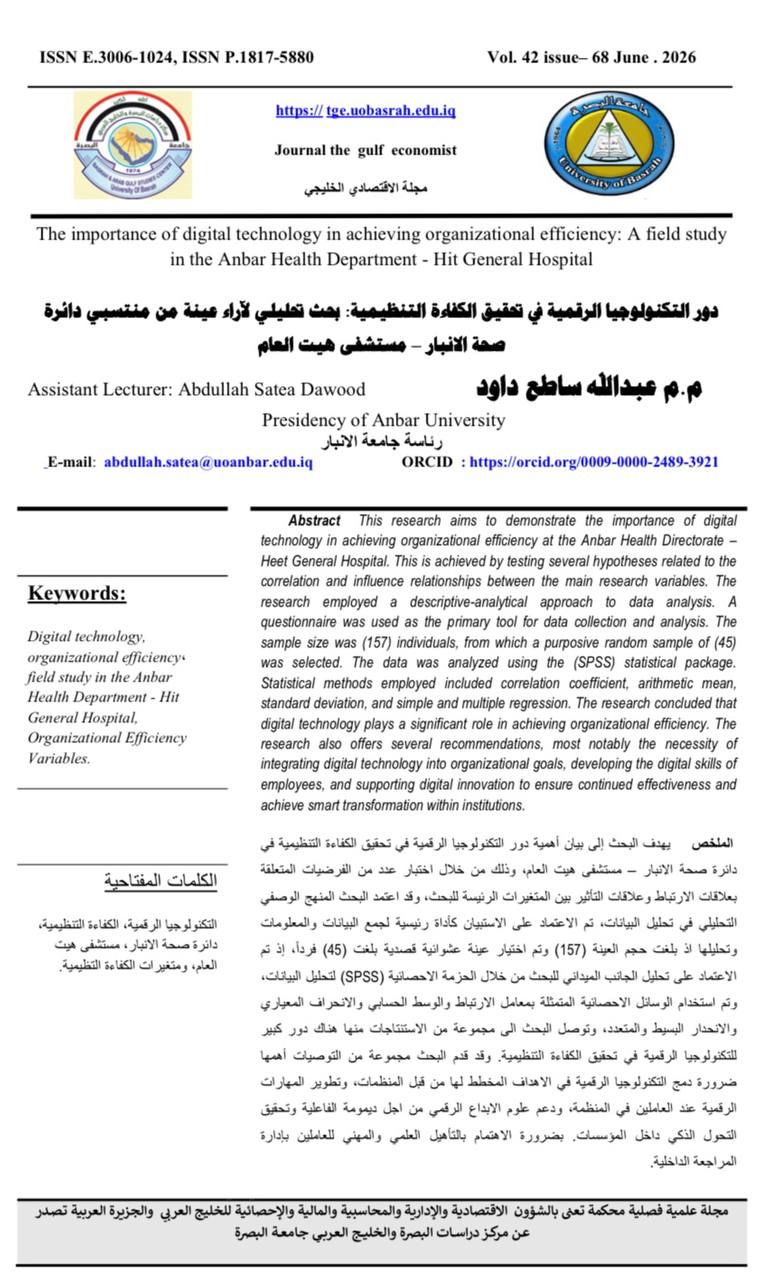
Abstract This research aims to demonstrate the importance of digital technology in achieving organizational efficiency at the Anbar Health Directorate – Heet General Hospital. This is achieved by testing several hypotheses related to the correlation and influence relationships between the main research variables. The research employed a descriptive-analytical approach to data analysis. A questionnaire was used as the primary tool for data collection and analysis. The sample size was (157) individuals, from which a purposive random sample of (45) was selected. The data was analyzed using the (SPSS) statistical package. Statistical methods employed included correlation coefficient, arithmetic mean, standard deviation, and simple and multiple regression. The research concluded that digital technology plays a significant role in achieving organizational efficiency. The research also offers several recommendations, most notably the necessity of integrating digital technology into organizational goals, developing the digital skills of employees, and supporting digital innovation to ensure continued effectiveness and achieve smart transformation within institutions.
Article Details

This work is licensed under a Creative Commons Attribution-ShareAlike 4.0 International License.
References
References
-Sahayu, W., Triyono, S., & Ungu, N. K. (2026). Digital technology in differentiated English language teaching: A systematic review with bibliometric insights. Indonesian Journal of Science and Technology, 11(1), 167-188.
-Yusuf, H., Fitri, A., & Razzaq, A. (2026). Using artificial intelligence for human-AI collaboration in knowledge management systems to improve organizational efficiency and learning. In Driving Organizational Transformation Through Human-Robotic Collaboration (pp. 35-48). IGI Global Scientific Publishing.
-Chaudron, S., Plowman, L., Beutel, M. E., Černikova, M., Navarette, V. D., Dreier, M., ... & Wölfling, K. (2015). Young children (0-8) and digital technology-EU report. Publications Office of the European Union.
-Wang, Y., Gong, C., Ji, X., & Yuan, Q. (2025). Text classification for evaluating digital technology adoption maturity based on BERT: An evidence of Industrial AI from China. Technological Forecasting and Social Change, 211, 123903.
-Lyu, W., & Liu, J. (2021). Artificial Intelligence and emerging digital technologies in the energy sector. Applied energy, 303, 117615.
-Sailer, M., Murböck, J., & Fischer, F. (2021). Digital learning in schools: What does it take beyond digital technology?. Teaching and Teacher Education, 103, 103346.
-Wang, L. (2024). The Impact of Network Load Balancing on Organizational Efficiency and Managerial Decision-Making in Digital Enterprises. Academic Journal of Sociology and Management, 2(4), 41-48.
-Inegbedion, H., Sunday, E., Asaleye, A., Lawal, A., & Adebanji, A. (2020). Managing diversity for organizational efficiency. Sage Open, 10(1).
-Feng, C., & Ali, D. A. (2024). Improving the organizational efficiency of manufacturing enterprises-the role of digital transformation, resource planning (ERP), and business practices. Journal of Law and Sustainable Development, 12(3), e2439-e2439.
-Harraf, A., Wanasika, I., Tate, K., & Talbott, K. (2015). Organizational agility. Journal of Applied Business Research, 31(2), 675.
-Blaga, P., & Jozsef, B. (2014). Increasing human resource efficiency in the production process. Procedia Technology, 12, 469-475.
-Binkley, D., Stape, J. L., & Ryan, M. G. (2004). Thinking about efficiency of resource use in forests. Forest Ecology and Management, 193(1-2), 5-16.
-Shonubi, A. O., & Akintaro, A. A. (2016). The impact of effective communication on organizational performance. International Journal of Social Sciences and Humanities Invention, 3(3), 1904–1914.
-Alshehri, A. M., & Alqurashi, S. M. (2024). The Impact of the New Public Service Model (NPS) on the Organizational Efficiency: A Field Study on the Saudi Ground Services Company. Journal of Economic, Administrative and Legal Sciences, 8(13), 25-43.
-Maggie, Abdel Fattah Mohamed Abdel Rahman Al-Khouli. (2024). The impact of digital technology on artistic creativity in children's drawings. Research in Art Education and Arts, 24(3), 575-583.
-Omar, Samra. (2023). Digital Technology and its Impact on the Development of Scientific Research. Approaches in Education 4(1), 61-73.
-Zaitouni, Sabira. (2025). Digital Technology and its Use in the Child's Educational Process. Al-Umda in Linguistics and Discourse Analysis 9(1), 228-247.
-Fawzia, Bouaoun and Nabila, Kara. (2025). Digital Technology and its Relationship to the Emergence of Anxiety and Aggressive Behavior among Adolescents. Journal of Studies in the Psychology of Deviance (02), 156-175.
- Hamza, Farkous and Sharif, Amrouche. (2022). Digital Technology as a Strategic Requirement for Improving Human Resource Performance - A Case Study of a Sample of Municipalities in the Blida Province. Journal of Management and Development for Research and Studies, 11(1), 487-506.
-Awissi, Sakina. (2025). The Impact of Using Digital Technology in Teaching Mathematics to Reduce Dyscalculia Among a Sample of Fourth-Grade Primary School Students in Ouargla (Doctoral dissertation, Kasdi Merbah University of Ouargla).
-Sayed El-Ahl, Mohamed El-Desouki. (2025). The Role of Organizational Competence as a Mediating Variable in the Relationship Between Organizational Climate and Career Growth. International Journal of Administrative, Economic and Financial Sciences 4(12), 120-200.
-Maiteeq, Moati Mohamed Omar. (2025). Strategic Planning and its Impact on Organizational Effectiveness. Afro-Asian Journal of Scientific Research (AAJSR), 343-357.
-Bouras, Fatima Zahra, Beriki, El-Ashabi & Fatima Zahra. (2024). The Impact of Human Resource Efficiency on Achieving Competitive Advantage (Doctoral dissertation, University of Ain Temouchent).
-Abdulsamad, Lotfi Ahmed Abdullah, and Al-Haddad, Khaled Mohamed Ibrahim. (2025). The Impact of Digital Technology on Developing Administrative Work in Higher Education Institutions (A Field Study on the Faculty of Arts and Sciences, Misrata). Al-Qalaa Journal, (March 24), 270-291.
-Al-Salawi, Intisar Mohsen. (2021). The Impact of Training in E-Management on Raising Organizational Efficiency from the Perspective of Employees at the International Islamic Solidarity Bank: A Study in the Sociology of Organization and Work. Journal of Arts, (19), 607-653.