The Economics of Industrial Transformation of Oil Rents and Efficiency Analysis of Building Productive Structures)A Comparative Study of Iraq, Saudi Arabia, and Norway)
Article Sidebar
Main Article Content
Abstract
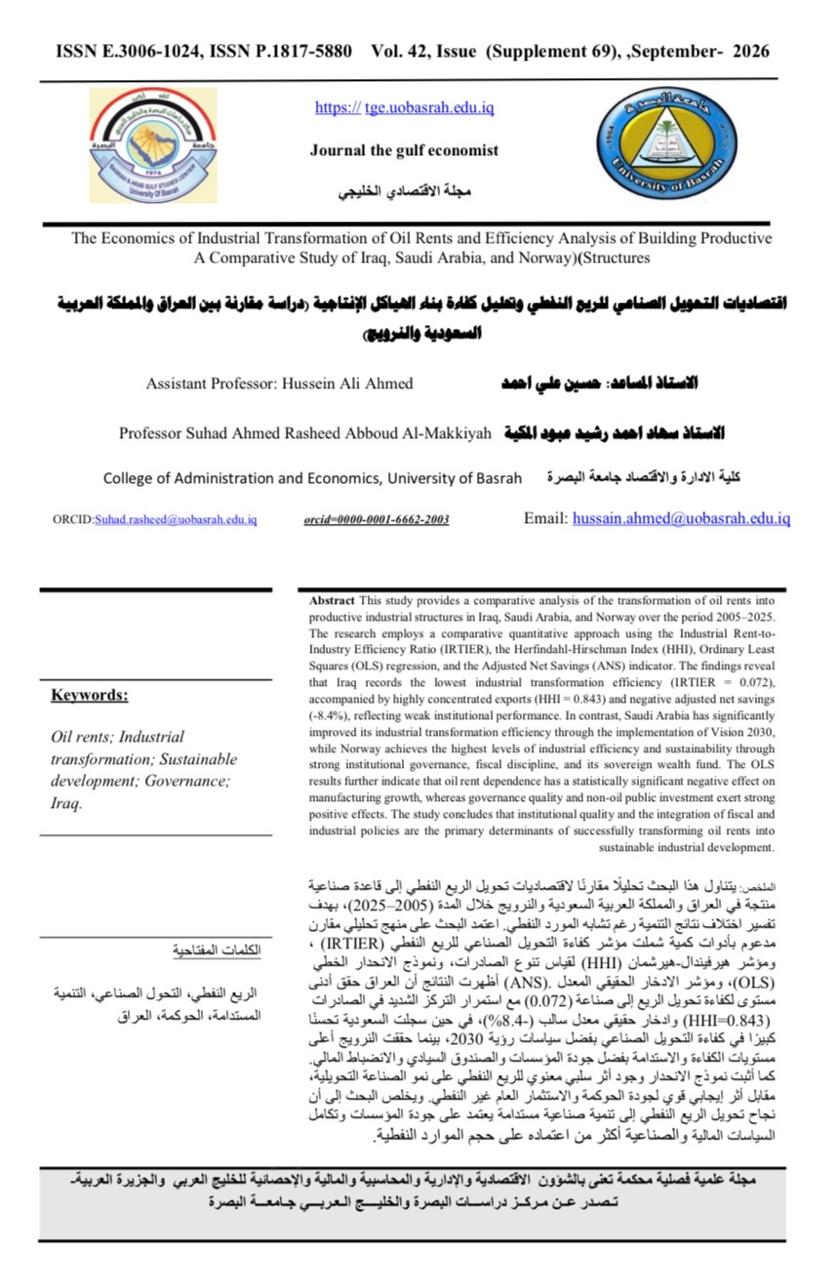
Abstract This study provides a comparative analysis of the transformation of oil rents into productive industrial structures in Iraq, Saudi Arabia, and Norway over the period 2005–2025. The research employs a comparative quantitative approach using the Industrial Rent-to-Industry Efficiency Ratio (IRTIER), the Herfindahl-Hirschman Index (HHI), Ordinary Least Squares (OLS) regression, and the Adjusted Net Savings (ANS) indicator. The findings reveal that Iraq records the lowest industrial transformation efficiency (IRTIER = 0.072), accompanied by highly concentrated exports (HHI = 0.843) and negative adjusted net savings (-8.4%), reflecting weak institutional performance. In contrast, Saudi Arabia has significantly improved its industrial transformation efficiency through the implementation of Vision 2030, while Norway achieves the highest levels of industrial efficiency and sustainability through strong institutional governance, fiscal discipline, and its sovereign wealth fund. The OLS results further indicate that oil rent dependence has a statistically significant negative effect on manufacturing growth, whereas governance quality and non-oil public investment exert strong positive effects. The study concludes that institutional quality and the integration of fiscal and industrial policies are the primary determinants of successfully transforming oil rents into sustainable industrial development.
Article Details

This work is licensed under a Creative Commons Attribution-ShareAlike 4.0 International License.
References
References
Acemoglu, D., & Robinson, J. A. (2012). Why nations fail: The origins of power, prosperity, and poverty. Crown Business. https://www.whynationsfail.com
Al Naimi, S. M. (2021). Economic diversification trends in the Gulf: The case of Saudi Arabia. Circular Economy and Sustainability, 2, 221–230. https://doi.org/10.1007/s43615-021-00106-0
AlKathiri, N., Atalla, T. N., Murphy, F., & Pierru, A. (2020). Optimal policies for managing oil revenue stabilization funds: An illustration using Saudi Arabia. Resources Policy, 67, 101686. https://doi.org/10.1016/j.resourpol.2020.101686
AL-Saadi, T., Cherepovitsyn, A., & Semenova, T. (2022). Iraq oil industry infrastructure development in the conditions of the global economy turbulence. Energies, 15(17), 6239. https://doi.org/10.3390/en15176239
Auty, R. M. (2001). Resource abundance and economic development. Oxford University Press. https://global.oup.com/academic/product/resource-abundance-and-economic-development-9780199246885
Beblawi, H. (1987). The rentier state in the Arab world. In H. Beblawi & G. Luciani (Eds.), The rentier state (pp. 49–62). Croom Helm. https://www.jstor.org/stable/41857943
Beblawi, H., & Luciani, G. (Eds.). (1987). The rentier state. Croom Helm. https://www.routledge.com/The-Rentier-State/Beblawi-Luciani/p/book/9781138923720
Corden, W. M. (1984). Booming sector and Dutch disease economics: Survey and consolidation. Oxford Economic Papers, 36(3), 359–380. https://doi.org/10.1093/oxfordjournals.oep.a041643
Corden, W. M., & Neary, J. P. (1982). Booming sector and de-industrialisation in a small open economy. The Economic Journal, 92(368), 825–848. https://doi.org/10.2307/2232670
Frontiers in Political Science. (2023). Rentier state theory: A 50-year review. https://doi.org/10.3389/fpos.2023.1111108
Hartwick, J. M. (1977). Intergenerational equity and the investing of rents from exhaustible resources. American Economic Review, 67(5), 972–974. https://www.osti.gov/biblio/5249208
International Monetary Fund. (2025). Iraq: 2025 Article IV consultation — Staff report. IMF. https://www.imf.org/-/media/files/publications/cr/2025/english/1irqea2025001-source-pdf.pdf
Luciani, G. (1990). Allocation vs. production states: A theoretical framework. In G. Luciani (Ed.), The Arab state (pp. 65–84). Routledge. https://www.taylorfrancis.com/chapters/edit/10.4324/9781315685229-4/allocation-vs-production-states-theoretical-framework-giacomo-luciani
Matallah, S. (2022). Rampant corruption: The dilemma facing economic diversification in oil-abundant MENA countries. Resources Policy, 75, 102541. https://doi.org/10.1016/j.resourpol.2021.102541
Mehlum, H., Moene, K., & Torvik, R. (2006). Institutions and the resource curse. The Economic Journal, 116(508), 1–20. https://doi.org/10.1111/j.1468-0297.2006.01045.x
Moses, J. W. (2021). Norway's sovereign wealth fund. In E. G. Pereira, R. Spencer, & J. W. Moses (Eds.), Sovereign wealth funds, local content policies and CSR (pp. 249–261). Springer. https://doi.org/10.1007/978-3-030-56092-8_13
Msann, G., & Karthiayani, V. P. (2023). Resource curse and growth challenges in MENA oil exporter countries. Regional Science Policy & Practice, 15(5), 992–1008. https://doi.org/10.1111/rsp3.12629
Murshed, S. M. (2023). The resource curse. Cambridge University Press. https://doi.org/10.1017/9781911116509
Norges Bank Investment Management. (2025). Government Pension Fund Global annual report 2024. NBIM. https://www.nbim.no/contentassets/490f9f062cfc4694b12c45f4d04ab0a5/annual_report_2024.pdf
Norges Bank Investment Management. (2026). Government Pension Fund Global annual report 2025. NBIM. https://www.nbim.no/contentassets/6db259ec684645ebbf171cacbe7cc7de/annual-report-2025.pdf
Norwegian Ministry of Finance. (2025). White paper on Government Pension Fund 2025 (Meld. St. 22, 2024–2025). Norwegian Ministry of Finance. https://www.regjeringen.no/contentassets/820e1658cc134386a6f8d5b488e76d4c/white-paper-on-government-pension-fund-2025-executive-summary.pdf
Norwegian Ministry of Finance. (2025). The fiscal policy guideline and GPFG spending (Budget 2026). Norwegian Ministry of Finance. https://www.regjeringen.no/contentassets/6b87b3bf3f2d43cc813e09630547cc9c/engelsk_kap_3.1.pdf
Ross, M. L. (2012). The oil curse: How petroleum wealth shapes the development of nations. Princeton University Press. https://doi.org/10.1515/9781400841929
Sachs, J. D., & Warner, A. M. (1995). Natural resource abundance and economic growth. NBER Working Paper No. 5398. https://www.nber.org/system/files/working_papers/w5398/w5398.pdf
Sachs, J. D., & Warner, A. M. (2001). The curse of natural resources. European Economic Review, 45(4–6), 827–838. https://doi.org/10.1016/S0014-2921(01)00125-8
Solow, R. M. (1986). On the intergenerational allocation of natural resources. Scandinavian Journal of Economics, 88(1), 141–149. https://doi.org/10.2307/3440280
United Nations Development Programme. (2024). Human development report 2023-24: Breaking the gridlock: Reimagining cooperation in a polarized world. UNDP. https://hdr.undp.org/content/human-development-report-2023-24
United Nations Industrial Development Organization. (2024). Manufacturing value added (MVA) and industrial statistics. UNIDO. https://www.unido.org/
Venables, A. J. (2016). Using natural resources for development: Why has it proven so difficult? Journal of Economic Perspectives, 30(1), 161–184. https://doi.org/10.1257/jep.30.1.161
Vision 2030 Annual Report. (2025). Saudi Arabia's Vision 2030 annual progress report 2025. Vision 2030. https://www.vision2030.gov.sa/media/ecdjfopq/vision2030_annual_report_2025_en.pdf
World Bank. (2023). The changing wealth of nations 2024. World Bank. https://documents.worldbank.org/en/publication/documents-reports/documentdetail/099100824155021548
World Bank. (2024). Worldwide Governance Indicators (WGI). World Bank. https://www.worldbank.org/en/publication/worldwide-governance-indicators
World Bank. (2025). World Development Indicators. World Bank. https://data.worldbank.org/