تأثير القيادة الاحتوائية في السياسة التنظيمية دراسة تطبيقية في الشركة العامة لإنتاج الطاقة الكهربائية في البصرة
الشريط الجانبي للمقالة
محتوى المقالة الرئيسي
الملخص
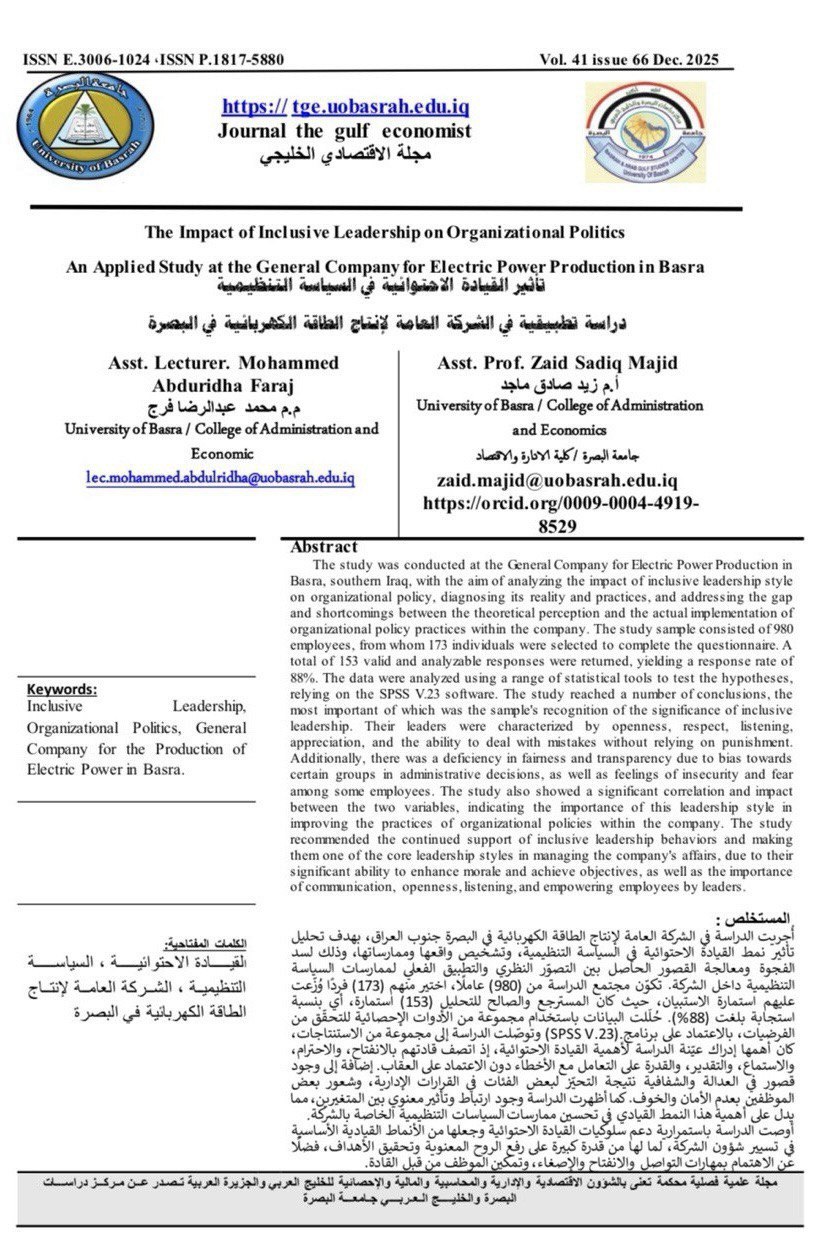
أُجريت الدراسة في الشركة العامة لإنتاج الطاقة الكهربائية في البصرة جنوب العراق، بهدف تحليل تأثير نمط القيادة الاحتوائية في السياسة التنظيمية، وتشخيص واقعها وممارساتها، وذلك لسد الفجوة ومعالجة القصور الحاصل بين التصوّر النظري والتطبيق الفعلي لممارسات السياسة التنظيمية داخل الشركة. تكوّن مجتمع الدراسة من (980) عاملًا، اختير منهم (173) فردًا وُزّعت عليهم استمارة الاستبيان، حيث كان المسترجع والصالح للتحليل (153) استمارة، أي بنسبة استجابة بلغت (88%). حُلّلت البيانات باستخدام مجموعة من الأدوات الإحصائية للتحقّق من الفرضيات، بالاعتماد على برنامج (SPSS V.23).وتوصّلت الدراسة إلى مجموعة من الاستنتاجات، كان أهمها إدراك عيّنة الدراسة لأهمية القيادة الاحتوائية، إذ اتصف قادتهم بالانفتاح، والاحترام، والاستماع، والتقدير، والقدرة على التعامل مع الأخطاء دون الاعتماد على العقاب. إضافة إلى وجود قصور في العدالة والشفافية نتيجة التحيّز لبعض الفئات في القرارات الإدارية، وشعور بعض الموظفين بعدم الأمان والخوف. كما أظهرت الدراسة وجود ارتباط وتأثير معنوي بين المتغيرين، مما يدل على أهمية هذا النمط القيادي في تحسين ممارسات السياسات التنظيمية الخاصة بالشركة.
أوصت الدراسة باستمرارية دعم سلوكيات القيادة الاحتوائية وجعلها من الأنماط القيادية الأساسية في تسيير شؤون الشركة، لما لها من قدرة كبيرة على رفع الروح المعنوية وتحقيق الأهداف، فضلًا عن الاهتمام بمهارات التواصل والانفتاح والإصغاء، وتمكين الموظف من قبل القادة.
تفاصيل المقالة

هذا العمل مرخص بموجب Creative Commons Attribution-ShareAlike 4.0 International License.
تخضع جميع المقالات المنشورة في المجلة لشروط ترخيص المشاع الإبداعي (CC BY 4.0)، والتي تتيح للمستخدمين إعادة استخدام، وتوزيع، ومشاركة العمل بشرط نسب الفضل للمؤلف الأصلي والمجلة بالشكل الصحيح..
المراجع
Ackaradejruangsri, P., Mumi, A., Rattanapituk, S., & Pakhunwanich, P. (2023). Exploring the determinants of young inclusive leadership in Thailand: Research taxonomy and theoretical framework. Journal of the Knowledge Economy, 14(4), 3696–3723.
Agba, M. S., & Agba, G. E. M. (2025). The digital economy and the global workforce: Cultivating inclusive leadership and global mindsets for managing diversity at a distance. International Journal of Public Management and Social Science Research, 1(2), 28-43.
Ashikali, E. (2023). The impact of inclusive leadership on employee decision-making in organizational politics.
Avolio, B. J., & Gardner, W. L. (2005). Authentic leadership development: Getting to the root of positive forms of leadership. The Leadership Quarterly, 16(3), 315-338.
Bass, B. M., & Riggio, R. E. (2006). Transformational Leadership (2nd ed.). Psychology Press.
Bhatnagar, J., & Aggarwal, S. (2022). Inclusive Leadership in Contemporary Organizations.
Bortini, P., Felisatti, E., Meneghetti, C., & Trento, C. (2015). Leadership and organizational learning: The role of inclusion. Journal of Workplace Learning, 27(1), 25–35. https://doi.org/10.1108/JWL-09-2014-0064
Bourke, J., & Dillon, B. (2016). The six signature traits of inclusive leadership: Thriving in a diverse new world. Deloitte University Press. https://www2.deloitte.com
Burakova, M., Mcdowall, A., & Bianvet, C. (2022). Are organisational politics responsible for turnover intention in French Firefighters? European Review of Applied Psychology, 72(5), 100764.
Burns, T. (1961). Micropolitics: Mechanisms of institutional change. Administrative Science Quarterly, 257–281.
Carmeli, A., & Schaubroeck, J. (2006). How LMX mediates the impact of team leadership on individual performance in teams. The Leadership Quarterly, 17(4), 524-539. https://doi.org/10.1016/j.leaqua.2006.03.002
Carmeli, A., et al. (2010). Inclusive leadership and employee involvement in creative tasks in the workplace: The mediating role of psychological safety. Creativity Research Journal, 22(3), 250–260. https://doi.org/10.1080/10400419.2010.504654
Cenkci, T., Yildiz, B., & Zengin, B. (2020). Inclusive leadership and job satisfaction: The mediating role of psychological empowerment. International Journal of Organizational Leadership, 9(2), 1–10.
Chang, P. C., Ma, G., & Lin, Y. Y. (2022). Inclusive leadership and employee proactive behavior: A cross-level moderated mediation model. Psychology Research and Behavior Management, 1797–1808.
Choudhary, R., Akhouri, A., & Ghosh, P. (2022). About and beyond leading uniqueness and belongingness: A conceptual model of inclusive leadership. Journal of Business Research, 149, 514-526. https://doi.org/10.1016/j.jbusres.2022.05.021
Delle, E. (2013). The influence of perception of organizational politics on employee job involvement and turnover intentions: Empirical evidence from Ghanaian organizations. European Journal of Business and Management, 5(9), 151–160.
Dhawan, S. (2022). Organizational policies and employee commitment: The mediating role of organizational culture. Journal of Business and Management Studies, 10(1), 45–62. https://doi.org/10.1234/jbms.v10i1.5678
DuBrin, A. J. (1978). Winning at office politics. Prentice Hall.
DuBrin, A. J. (2001). Winning at office politics: How to achieve your objectives and increase your influence at work. 2nd ed. Prentice Hall.
Elvsetuen, T. G., Nesset, E., & Solberg, H. A. (2021). The inclusive leader: Measuring inclusiveness in organizations. Scandinavian Journal of Management, 37(3), 101–113.
Fang, E. E., & Jin, Z. (2014). Inclusive leadership: A new approach to leadership in the Chinese context. Journal of Business Research, 67(2), 213-220.
Ferris, G. R., & Kacmar, K. M. (1992). Perceptions of organizational politics. Journal of Management, 18(1), 93–116.
Ferris, G. R., Treadway, D. C., Kolodinsky, R. W., et al. (2017). Organizational politics and behavior. Routledge.
Gao, Z., & Zhao, C. (2014). Does organizational politics at the workplace harm employees' job performance? A person-organization fit perspective. Acta Psychologica Sinica.
Goleman, D. (2000). Leadership That Gets Results. Harvard Business Review, March-April.
Goleman, D., Boyatzis, R. E., & McKee, A. (2002). Primal leadership: Realizing the power of emotional intelligence. Boston, MA: Harvard Business School Press.
Gull, S., & Zaidi, A. A. (2012). Impact of organizational politics on employees' job satisfaction in the health sector of Lahore, Pakistan. Interdisciplinary Journal of Contemporary Research in Business, 4(2), 156–170.
Hussein, Israa Tareq. (2025). The Role of Inclusive Leadership in Organizational Favoritism: An Exploratory Study of the Views of a Sample of Employees in the Nineveh Directorate of Education. Journal of Applied Economic and Business Research, 7(1), Part Two.
He, Q. (2025). The influence of organizational policies on firm environmental performance through sustainable technologies and innovation and stakeholder concerns. Scientific Reports, 15(1), 10019. https://doi.org/10.1038/s41598-025-94499-9
Hoch, J. E. (2013). Shared leadership and innovation: The role of vertical leadership and employee integrity. Journal of Business and Psychology, 28(2), 159–174.
Hollander, E. P. (2008). Inclusive leadership: The essential leader-follower relationship. New York: Routledge.
Innstrand, S. T., & Grødal, K. (2021). Antecedents and consequences of perceived inclusion in academia. International Journal of Environmental Research and Public Health, 19(1), 431.
Kark, R., Shamir, B., & Chen, G. (2003). The two faces of transformational leadership: Empowerment and dependency. Journal of Applied Psychology, 88(2), 246–255.
Khairy, S., et al. (2022). Examining organizational behavior in Iraqi organizations: A study of leadership and management practices. University of Baghdad Press.
Kingsley, C. C., Hapriza, A., & Syaharizatul, N. M. (2018). Investigating the impact of organizational policy towards quality of work life on employee engagement in manufacturing company Nigeria. European Journal of Economics and Business Studies. https://doi.org/10.26417/EJES.V4I2.P146-158
Li, Yu Y. (2020). Impact of Inclusive Leadership on Employees' Adaptive Performance, International Conference on Education Science and Economic Development. Advances in Economics, Business and Management Research, volume 116.
Mintzberg, H. (1983). Power in and Around Organizations. Prentice-Hall.
Nejat, M., & Shafaei, A. (2023). The role of inclusive leadership in fostering organisational learning behaviour. Management Research Review, 46(12), 1661–1678. https://doi.org/10.1108/MRR-10-2022-0716
Nembhard, I. M., & Edmondson, A. C. (2006). Making it safe: The effects of leader inclusiveness and professional status on psychological safety and improvement efforts in health care teams. Journal of Organizational Behavior, 27(7), 941–966.
Nembhard, I. M., & Edmondson, A. C. (2006). Making it safe: The effects of leader inclusiveness and professional status on psychological safety and improvement efforts in health care teams. Journal of Organizational Behavior, 27(7), 941-966. https://doi.org/10.1002/job.413
Northouse, P. G. (2016). Leadership: Theory and Practice (7th ed.). Sage Publications.
Northouse, P. G. (2018). Leadership: Theory and Practice (8th ed.). Sage Publications.
Pfeffer, J. (1992). Understanding power in organizations. California Management Review, 34(2), 29–50.
Pfeffer, J. (2010). Power: Why Some People Have It and Others Don’t. HarperBusiness.
Poon, J. M. (2004). Effects of performance appraisal politics on job satisfaction and turnover intention. Personnel Review, 33(3), 322–334.
Qi, L., Liu, B., Wei, X., & Hu, Y. (2019). Inclusive leadership and employee proactive behavior: A moderated mediation model. Frontiers in Psychology, 10, 1802. https://doi.org/10.3389/fpsyg.2019.01802
Randel, A. E., Galvin, B. M., Shore, L. M., et al. (2018). Inclusive leadership: Realizing positive outcomes through belongingness and being valued for uniqueness. Human Resource Management Review, 28(2), 190–203. https://doi.org/10.1016/j.hrmr.2017.07.002
Rajab, Rasha Ahmed. (2024). Organizational Policy and Its Impact on Crisis Management Phases: An Exploratory Study in the General Commission for Dams and Reservoirs - Iraqi Ministry of Water Resources – Baghdad. Journal of Economic and Administrative Studies, 3(2).
Robbins, S. P., & Judge, T. A. (2017). Organizational Behavior (16th ed.). Pearson Education.
Robbins, S. P., & Judge, T. A. (2021). Organizational behavior (18th ed.). Pearson Education Limited, Harlow, England.
Roberson, Q., & Perry, J. L. (2022). Inclusive leadership in thought and action: A thematic analysis. Group & Organization Management, 47(4), 755–778.
Shore, L. M., Cleveland, J. N., & Sanchez, D. (2011). Inclusive workplaces: A review and model. Human Resource Management Review, 21(4), 271-290. https://doi.org/10.1016/j.hrmr.2010.10.004
Shore, L. M., et al. (2011). Inclusion and diversity in work groups: A review and model for future research. Journal of Management, 37(4), 1262–1289.
Shore, L. M., Randel, A. E., Chung, B. G., Dean, M. A., Ehrhart, K. H., & Singh, G. (2011). Inclusion and diversity in work groups: A review and model for future research. Journal of Management, 37(4), 1262–1289. https://doi.org/10.1177/0149206310385943
SHRM. (2023). Organizational politics. Society for Human Resource Management. Retrieved from https://www.shrm.org/resourcesandtools/tools-and-samples/toolkits/pages/organizationalpolitics.aspx
Umrani, W. A., Bachkirov, A. A., Nawaz, A., Ahmed, U., & Pahi, M. H. (2023). Inclusive leadership, employee performance and well-being: An empirical study. Leadership & Organization Development Journal.
Vigoda, E. (2003). Workplace politics and employee performance. Journal of Managerial Psychology, 18(3), 138–155.
Wu, G. F., & Li, M. (2023). Impact of inclusive leadership on employees’ innovative behavior: A relational silence approach. Frontiers in Psychology, 14, 1144791.
Zheng, X. X., Diaz, I., Zheng, X. T., & Tang, N. Y. (2017). From deep-level similarity to taking charge: The moderating role of face consciousness and managerial competency of inclusion. Leadership & Organization Development Journal, 38(1), 89–104.