أثر مؤشرات الشمول المالي على الانفتاح التجاري في العراق: دراسة قياسية للمدة (2010-2024)
الشريط الجانبي للمقالة
محتوى المقالة الرئيسي
الملخص
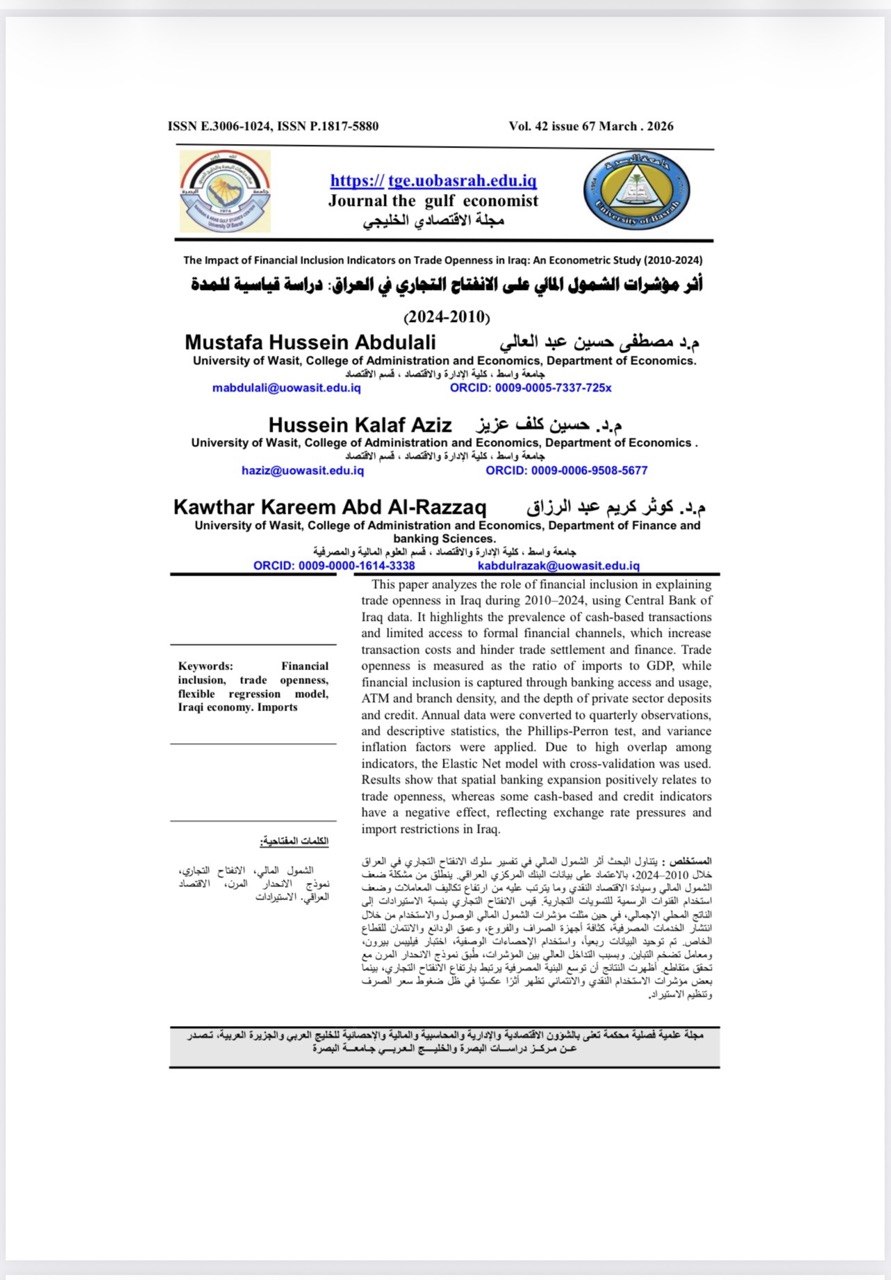
: يتناول البحث أثر الشمول المالي في تفسير سلوك الانفتاح التجاري في العراق خلال 2010–2024، بالاعتماد على بيانات البنك المركزي العراقي. ينطلق من مشكلة ضعف الشمول المالي وسيادة الاقتصاد النقدي وما يترتب عليه من ارتفاع تكاليف المعاملات وضعف استخدام القنوات الرسمية للتسويات التجارية. قيس الانفتاح التجاري بنسبة الاستيرادات إلى الناتج المحلي الإجمالي، في حين مثلت مؤشرات الشمول المالي الوصول والاستخدام من خلال انتشار الخدمات المصرفية، كثافة أجهزة الصراف والفروع، وعمق الودائع والائتمان للقطاع الخاص. تم توحيد البيانات ربعياً، واستخدام الإحصاءات الوصفية، اختبار فيليبس بيرون، ومعامل تضخم التباين. وبسبب التداخل العالي بين المؤشرات، طُبق نموذج الانحدار المرن مع تحقق متقاطع. أظهرت النتائج أن توسع البنية المصرفية يرتبط بارتفاع الانفتاح التجاري، بينما بعض مؤشرات الاستخدام النقدي والائتماني تظهر أثرًا عكسيًا في ظل ضغوط سعر الصرف وتنظيم الاستيراد.
تفاصيل المقالة

هذا العمل مرخص بموجب Creative Commons Attribution-ShareAlike 4.0 International License.
المراجع
Al Mazroui, Saeed, and Al Marzouqi, Ahmed. (2021). Financial Inclusion and Economic Growth in the United Arab Emirates. Arab Journal of Management, Vol. 41, No. 4.
Al-Ghamdi, Abdullah, Al-Ghamdi, Muhammad, and Al-Ghamdi, Abdulrahman. (2020). The Impact of Financial Inclusion on Small and Medium Enterprises in the Kingdom of Saudi Arabia. Journal of King Saud University (Administrative Sciences), Volume 32, Issue 2.
Al-Issawi, Ibrahim. (1989). Measuring Dependency in the Arab World. Beirut: Center for Arab Unity Studies.
Al-Nasrawi, Ali Ismail Abdul-Majid. (2022). The Impact of Trade Openness on Some Macroeconomic Variables in Iraq: A Case Study for the Period (2004-2024) [Unpublished Doctoral Dissertation]. College of Administration and Economics, University of Karbala.
Al-Rifai, Khalid, and Al-Hussein, Muhammad. (2015). Financial Inclusion in Qatar: An Analytical Study. Qatar Central Bank Working Papers Series, No. 4.
Al-Saffar, Firas Hussein Ali. (n.d.). Measuring and analyzing the impact of trade liberalization on economic growth in Iraq. Ibn Khaldun Journal of Studies and Research, 3(6).
Arab Monetary Fund. (2021). The Role of Financial Inclusion in Achieving Sustainable Development Goals in Arab Countries. Economic Studies, No. 54, Abu Dhabi.
Arab Monetary Fund.2017Requirements for adopting a comprehensive national strategy to promote financial inclusion in Arab countries. Abu Dhabi.
Bouhenia, Fali, and Djaghel, Jamila. (2023). Financial inclusion as a tool to contain the informal economy - the Arab Republic of Egypt as a model. Journal of Economics and Business Administration, 07(01), Special Issue.
Central Bank of Iraq. (2016). Annual Financial Stability Report. Baghdad, Iraq.
Demirgüç-Kunt, A., Klapper, L., Singer, D., Ansar, S., & Hess, J. (2022). The Global Findex Database 2021. World Bank.
Djulius, H. (2017). Energy use, trade openness, and exchange rate impact on foreign direct investment in Indonesia. International Journal of Energy Economics and Policy, 7(5).
Dupont, M., & Lacoste, F. (2016). Financial Inclusion in France: An Analytical Study. European Economic Review, 18(4).
Edwards, S. (1998). Openness, productivity and growth: What do we really know? The Economic Journal, 108(447).
Eurostat. (2018). ESS guidelines on temporal disaggregation, benchmarking and reconciliation. Publications Office of the European Union.
Fahad, M. (2023). Financial Inclusion and Economic Development in Malaysia. Journal of Asian Economics, 29(1).
Guay, A., & Maurin, E. (2015). Disaggregation methods based on MIDAS regression. Economic Modelling, 50.
Hassan, Noor Sabah, and Al-Azzawi, Karim Abis. (2023). The Impact of Financial Inclusion Indicators on the Problem of Poverty in Iraq for Selected Years. Journal of Management and Economics, Vol. 46, No. 138.
Hastie, T., Tibshirani, R., & Wainwright, M. (2015). Statistical Learning with Sparsity The Lasso and Generalizations. CRC Press.
Hyndman, R. J., & Athanasopoulos, G. (2021). Forecasting Principles and Practice (3rd ed.). OTexts.
International Monetary Fund. (2017). Benchmarking and Reconciliation. In Quarterly National Accounts Manual 2017 Edition, Chapter 6. IMF.
International Monetary Fund. (2017). Quarterly National Accounts Manual 2017 Edition. IMF.
International Monetary Fund. (2020). Financial Access Survey Trends and Developments 2020. IMF.
Ismail, Abdul Majeed, and Al-Ta'i, Ali Imran Hussein. (2018). Measuring and analyzing the impact of trade liberalization on some economic variables in Iraq for the period (2013-2017). Journal of the University of Karbala Scientific, 16(4).
James, G., Witten, D., Hastie, T., & Tibshirani, R. (2021). An Introduction to Statistical Learning With Applications in R (2nd ed.). Springer.
Jawad, Kamal Kadhim, and Abdul Hussein, Ghufran Muhammad. (2025). The Causal Relationship Between Financial Inclusion and Financial Resilience: An Analytical Study of the Iraqi Banking Sector, Represented by the Central Bank of Iraq (2010-2020). Warith Scientific Journal.
Kharroubi Laqwas, Ahmed. (2023). Financial Inclusion as a Mechanism for Achieving Financial Stability - The Saudi Arabian Experience. Journal of Economics and Management Research, 04 (01), Special Issue.
Li, M., & Wang, J. (2020). Financial Inclusion and Human Development in China: An Analytical Study. China Economic Journal, 12(3).
Naimi, Rachid, and Ben Sassi, Abdelhafid. (2023). The role of the World Bank in promoting financial inclusion in developing countries - a case study of Algeria. Journal of Economics and Management Research, 04 (01), Special Issue.
Saeed, Mushtaq Latif. (2025). The impact of financial inclusion on economic growth in Iraq during the period (2010-2024). Journal of Imam University College for Human Sciences, 2(8).
Schreiber-Gregory, D. (2021). Mitigating Multicollinearity Using Regularization Techniques to Minimize the Effect of Collinearity. PharmaSUG 2021 Proceedings, Paper HT-127.
Sercu, P. (2020). EC2 Lecture 16 Unit Root Testing Including Phillips–Perron. University of Houston.
Sjö, B. (2019). Testing for Unit Roots and Cointegration A Guide.
Tay, K., Friedman, J., Hastie, T., & Tibshirani, R. (2023). Elastic Net Regularization Paths for All Generalized Linear Models via Coordinate Descent. Journal of Statistical Software, 106(1).
World Bank. (2021). Financial Inclusion Support Framework. Retrieved from: https://www.worldbank.org/en/topic/financialinclusion/brief/financial-inclusion-support-framework.
Wu, J., & Li, M. (2018). Financial Inclusion and Economic Growth: An Empirical Study of MENA Countries. Journal of International Development, 22(2).
Zhang, R., & Chen, B. (2021). Financial inclusion in China: progress and barriers. Financial Innovation, 7(1), Article 24.https://doi.org/10.1186/s11782-021-00098-6