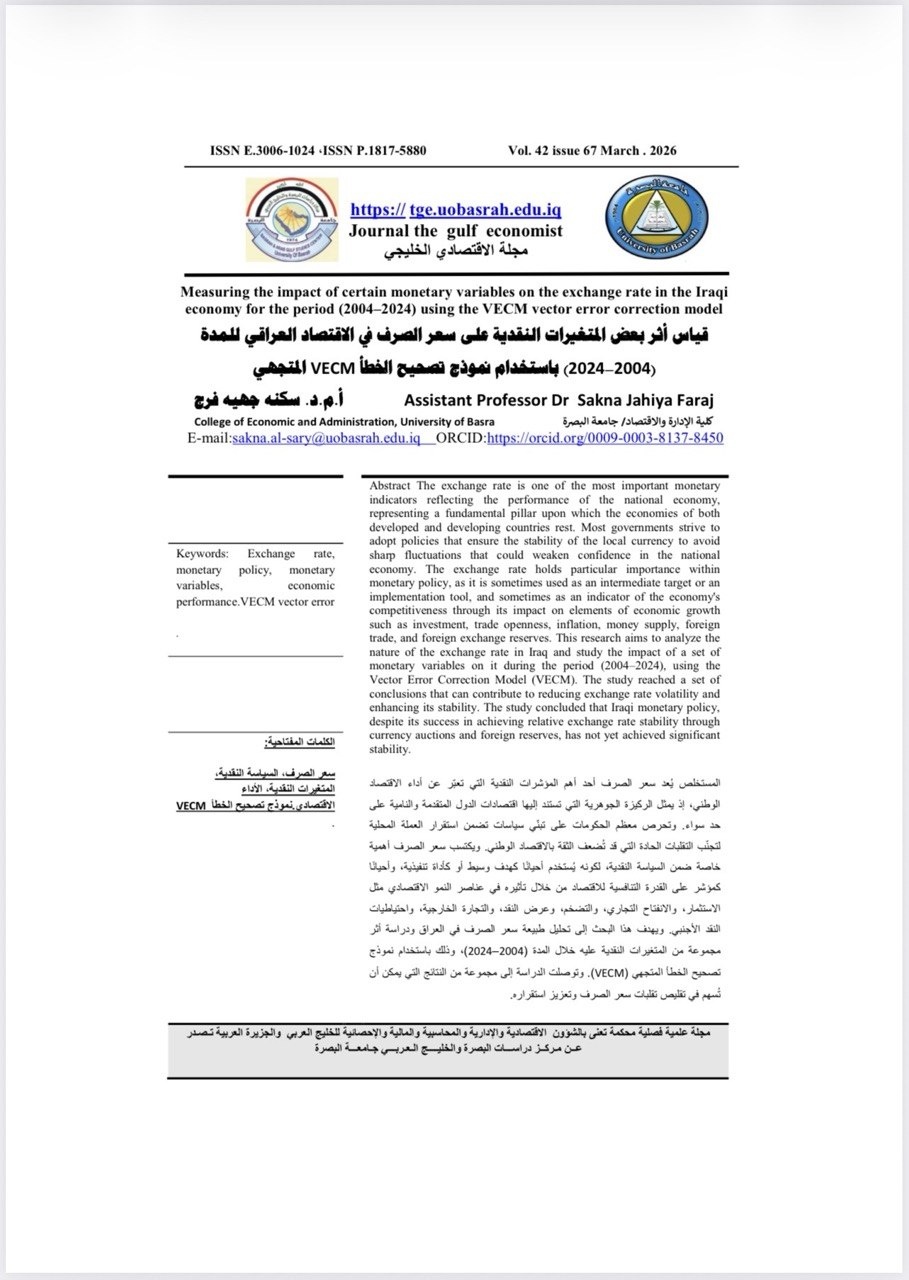
Measuring the impact of certain monetary variables on the exchange rate in the Iraqi economy for the period (2004–2024) using the VECM vector error correction model
Article Sidebar
Main Article Content
Abstract
The exchange rate is one of the most important monetary indicators reflecting the performance of the national economy, representing a fundamental pillar upon which the economies of both developed and developing countries rest. Most governments strive to adopt policies that ensure the stability of the local currency to avoid sharp fluctuations that could weaken confidence in the national economy. The exchange rate holds particular importance within monetary policy, as it is sometimes used as an intermediate target or an implementation tool, and sometimes as an indicator of the economy's competitiveness through its impact on elements of economic growth such as investment, trade openness, inflation, money supply, foreign trade, and foreign exchange reserves. This research aims to analyze the nature of the exchange rate in Iraq and study the impact of a set of monetary variables on it during the period (2004–2024), using the Vector Error Correction Model (VECM). The study reached a set of conclusions that can contribute to reducing exchange rate volatility and enhancing its stability. The study concluded that Iraqi monetary policy, despite its success in achieving relative exchange rate stability through currency auctions and foreign reserves, has not yet achieved significant stability.
Article Details

This work is licensed under a Creative Commons Attribution-ShareAlike 4.0 International License.
References
Bourdeaux, Michael (2002). The Historical Perspective on Exchange Rate System Selection, Exchange Rate Systems and Policies Conference, Economic Policy Institute, Arab Monetary Fund.
Jarrah, Naeem Sabah, et al. (2019). The Impact of Indirect Quantitative Monetary Policy Instruments on Financial Stability Indicators in Iraq (2003–2016), Journal of Economic and Administrative Sciences, Vol. 25, No. 110.
Al-Jubouri, Sawsan Karim Hodan, and Sakban, Qasim Saad (2019). The Impact of Some Monetary Indicators on the Exchange Rate of the Iraqi Dinar (1990–2016), Ahlulbayt Journal, No. 24.
Al-Husseini, Arqan Taqi (1999). International Finance, Dar Majdalawi, Amman.
Al-Khazraji, Thuraya (2010). Monetary Policy in Iraq: Between Past Accumulations and Present Challenges, Baghdad College of Economic Sciences Journal, No. 23.
Al-Anzi, Hawraa Jassim Mohammed (2015). The Impact of Monetary Stability on Some Economic Variables Under the Independence of the Central Bank of Iraq (1990–2012), Master's Thesis, University of Karbala.
Al-Ghalibi, Abdul Hussein Jalil (2017). Foreign Exchange Rate Policy and the Double Shock in the Iraqi Economy, Journal of Monetary and Financial Studies, Special Issue of the Third Annual Conference.
Al-Ghalibi, Abdul Hussein Jalil and Al-Jubouri, Sawsan Karim (2017). The Impact of Central Bank Independence on Some Macroeconomic Variables in Iraq (1991–2013), Al-Ghari Journal of Economic and Administrative Sciences, Volume 14, Issue 3.
Khudair, Laila Badiwi (2009). Real Exchange Rate Movements Under Trade Liberalization in Some Arab Countries (1984–2006), Master's Thesis, University of Kufa.
Saqr, Ahmed (1993). Macroeconomic Theory, Publications Agency, Kuwait.
Al-Taher, Atrash (2007). Banking Techniques, 6th Edition, University Publications Office, Algeria.
Abbas, Mahmoud Bakheet Shawky (2014). The Impact of Exchange Rate Fluctuations on the Inflation Rate in Egypt (1991–2010), Master's Thesis, Sohag University.
Abdelkader, Mourad (2011). The Impact of Monetary Changes on the Exchange Rate of the Algerian Dinar against the US Dollar (1974–2003), Master's Thesis, Kasdi Merbah University – Ouargla.
Kazem, Tabarak Faid (2017). Monetary Policy and its Role in Achieving Monetary Stability in Iraq, Journal of Economic and Administrative Studies, Al-Qadisiyah University, Issue 22, Volume 1.
Suleiman and Dawood, Mustafa, Hossam (2000), Principles of Macroeconomics, Dar Al-Maysara, Jordan.
Al-Naqa, Ahmed Abu Al-Futouh (2012). The Quantitative Approach to the Impact of Monetary Policy and its Channels, Afaq Jadida Journal, Menoufia University, Issue 3. 17. Ministry of Finance, Central Bank of Iraq Economic Report, various years (2003–2023).
Ministry of Planning, Central Statistical Organization, Annual Bulletins (2004–2024).
Ministry of Planning, National Income and Gross Domestic Product in Iraq, Baghdad, for the period (2004–2024).
Dickey, D. A. & Fuller, W. A. (1981). Likelihood Ratio Statistics for Autoregressive Time Series with a Unit Root, Econometrica, Vol. 49.
Phillips, P. C. B. (1986). Understanding Spurious Regression in Economics, Journal of Econometrics, Vol. 33.
Hall, D., Anderson, H. M., & Granger, C. W. J. (1994). A Co-integration Analysis of Treasury Bill Yield, Review of Economics and Statistics, Vol. 74.