التنمية البشرية ضرورة للحد من الفقر في العراق
الشريط الجانبي للمقالة
محتوى المقالة الرئيسي
الملخص
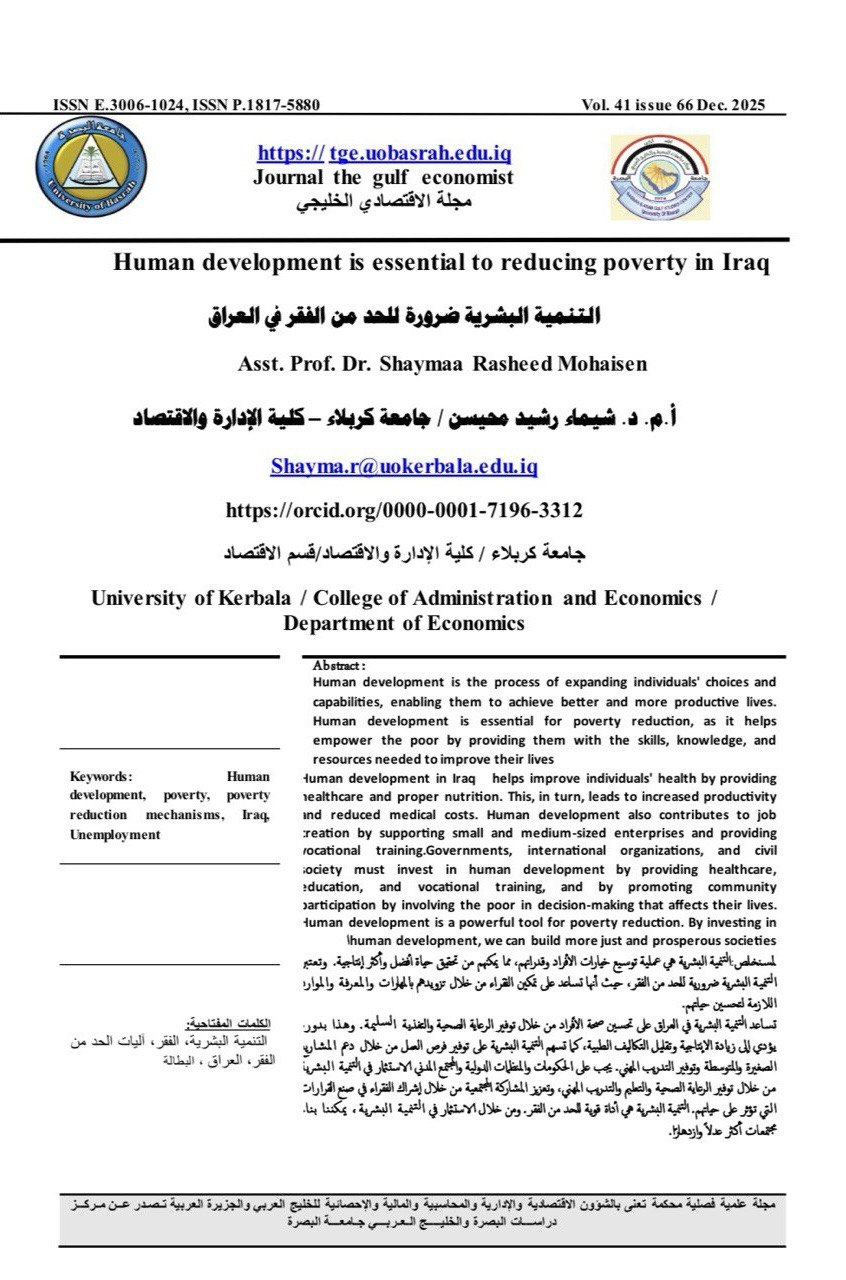
التنمية البشرية هي عملية توسيع خيارات الأفراد وقدراتهم، مما يمكنهم من تحقيق حياة أفضل وأكثر إنتاجية. وتعتبر التنمية البشرية ضرورية للحد من الفقر، حيث أنها تساعد على تمكين الفقراء من خلال تزويدهم بالمهارات والمعرفة والموارد اللازمة لتحسين حياتهم.
تساعد التنمية البشرية في العراق على تحسين صحة الأفراد من خلال توفير الرعاية الصحية والتغذية السليمة. وهذا بدوره يؤدي إلى زيادة الإنتاجية وتقليل التكاليف الطبية، كما تسهم التنمية البشرية على توفير فرص العمل من خلال دعم المشاريع الصغيرة والمتوسطة وتوفير التدريب المهني. يجب على الحكومات والمنظمات الدولية والمجتمع المدني الاستثمار في التنمية البشرية من خلال توفير الرعاية الصحية والتعليم والتدريب المهني، وتعزيز المشاركة المجتمعية من خلال إشراك الفقراء في صنع القرارات التي تؤثر على حياتهم. التنمية البشرية هي أداة قوية للحد من الفقر. ومن خلال الاستثمار في التنمية البشرية، يمكننا بناء مجتمعات أكثر عدلاً وازدهارًا
تفاصيل المقالة

هذا العمل مرخص بموجب Creative Commons Attribution-ShareAlike 4.0 International License.
تخضع جميع المقالات المنشورة في المجلة لشروط ترخيص المشاع الإبداعي (CC BY 4.0)، والتي تتيح للمستخدمين إعادة استخدام، وتوزيع، ومشاركة العمل بشرط نسب الفضل للمؤلف الأصلي والمجلة بالشكل الصحيح..
المراجع
- Foujo, Maison Zaki (2012), Human Development Strategies and Their Role in Reducing the Phenomenon of Scientific Talent Migration in Palestine (A Case Study of the Gaza Strip), Master's Thesis, Islamic University, Faculty of Commerce, Gaza.
- Allam, Saad Taha. Abdel Al, Farid Ahmed (2012), Human Development Economics, Anglo-Egyptian Library, Egypt.
- Ahmed, Ahmed Abdel Al (2021), Human Development, edited by Rafed Allam, Al-Mashreq Electronic Library, Egypt.
- Ahmed Jaber Badran. (2014). Economic Development and Sustainable Development. Cairo: First Edition, Center for Jurisprudential Studies.
- Ahmed Aref Al-Assaf. (2011). Planning and Economic Development. Amman, First Edition: Al-Maseera House for Publishing, Distribution, and Printing.
- Ahmed Ali Daghim. (2006). The Path to Economic Miracle and Completely Eliminating Unemployment in Developing Countries (China Practically Confirms the Success of Its Idea). Cairo: First Edition, Academic Library.
- Hamad Omar Al-Rawi. (2010). Unemployment in Iraq – Reality and Challenges of Solutions, Iraqi Journal of Economic Sciences, Iraqi Journal of Economic Sciences, Year 8, Issue 26.
- Ismail Mohammed Al-Ziyoud. (2020). The Role of Small Development Projects in Rural Development, Dar Jalees Al-Zaman Publishing and Distribution, Amman
- National Human Development Report. (2014). National Human Development Report, Youth of Iraq: Challenges and Opportunities, 1st edition.
- Republic of Iraq. (2018). Poverty Reduction Strategy. Ministry of Planning, Poverty Reduction Strategy in Iraq.
- Susan Ali Marza. (2014). The Private Sector and Its Economic Role in Solving the Unemployment Problem in Iraq in Selected Countries with Special Reference to Iraq, Master's Thesis, College of Administration and Economics, University of Karbala
- Al-Din Banfa. (2018). The Evolution of Poverty Concepts and Income Distribution during the Period (1960-2017). Arab Planning Institute, Kuwait.
- Mohamed Al-Banna. (2008). Analytical Economics. University Press, Alexandria.
- Michel. (2006). Economic Development, Arabic translation by Mahmoud Hassan Hosni. Saudi Arabia: Al-Mareekh Publishing House
- Central Bank of Iraq Statistics - Directorate General of Statistics and Research, and Ministry of Planning – Central Statistical Organization for different years.
- International Monetary Fund, Country Report No. 235/15, 2015, p.33.
- Nidal Al-Hashimi, Ghufran Al-Jubouri, Diagnosing the Impact of Economic Sanctions on Macroeconomic Variables – An Econometric Study, Journal of Baghdad College of Economic Sciences, University, Issue 5, 2002, p.123.
- Source: Department of Statistics and Geographic Information Systems, Results of Household Surveys for the years 2007, 2012, 2018, 2024