Human development is essential to reducing poverty in Iraq
Article Sidebar
Main Article Content
Abstract
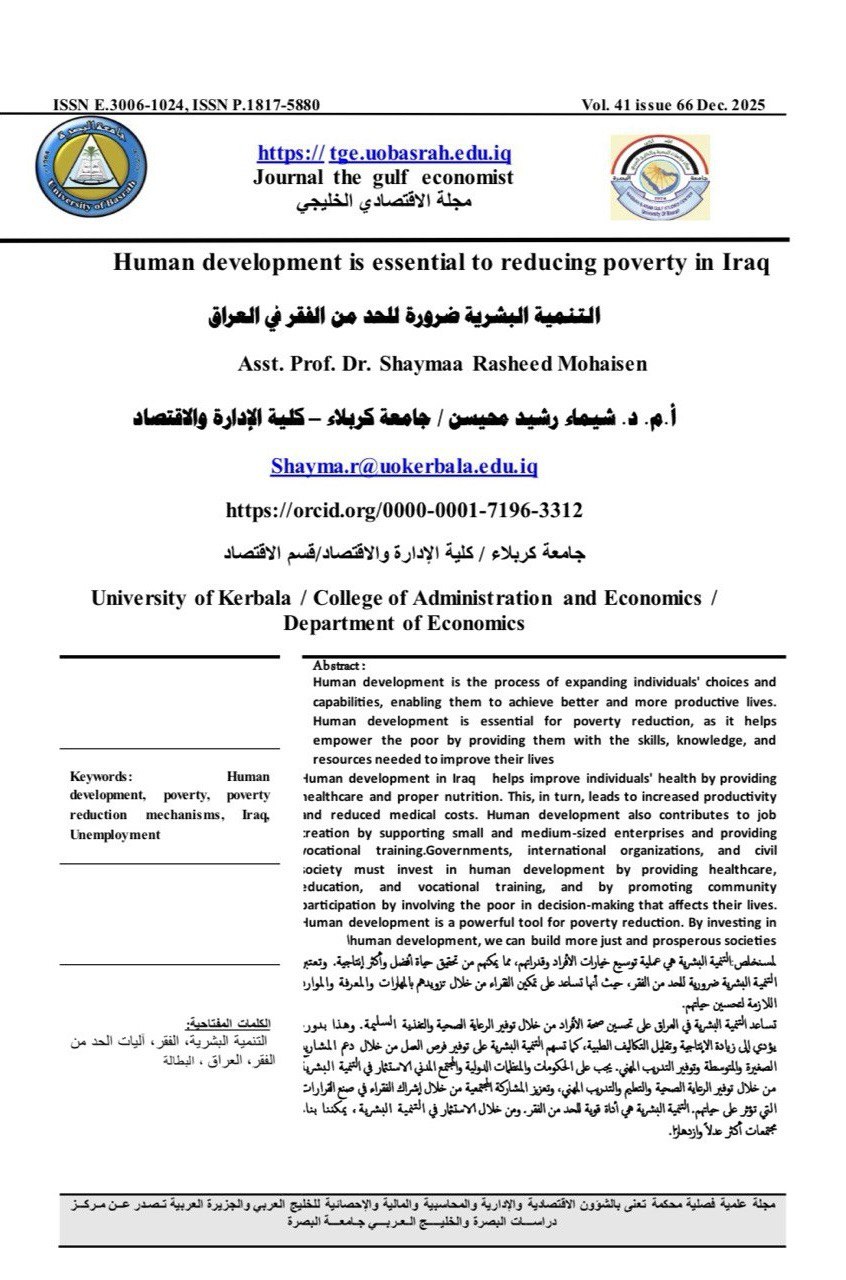
Human development is the process of expanding individuals' choices and capabilities, enabling them to achieve better and more productive lives. Human development is essential for poverty reduction, as it helps empower the poor by providing them with the skills, knowledge, and resources needed to improve their lives
Human development in Iraq helps improve individuals' health by providing healthcare and proper nutrition. This, in turn, leads to increased productivity and reduced medical costs. Human development also contributes to job creation by supporting small and medium-sized enterprises and providing vocational training.Governments, international organizations, and civil society must invest in human development by providing healthcare, education, and vocational training, and by promoting community participation by involving the poor in decision-making that affects their lives. Human development is a powerful tool for poverty reduction. By investing in human development, we can build more just and prosperous societiesا
Article Details

This work is licensed under a Creative Commons Attribution-ShareAlike 4.0 International License.
All articles published in the journal are licensed under the Creative Commons Attribution 4.0 International License (CC BY 4.0), which permits users to reuse, distribute, and share the work, provided that appropriate credit is given to the original author and the journal.
References
- Foujo, Maison Zaki (2012), Human Development Strategies and Their Role in Reducing the Phenomenon of Scientific Talent Migration in Palestine (A Case Study of the Gaza Strip), Master's Thesis, Islamic University, Faculty of Commerce, Gaza.
- Allam, Saad Taha. Abdel Al, Farid Ahmed (2012), Human Development Economics, Anglo-Egyptian Library, Egypt.
- Ahmed, Ahmed Abdel Al (2021), Human Development, edited by Rafed Allam, Al-Mashreq Electronic Library, Egypt.
- Ahmed Jaber Badran. (2014). Economic Development and Sustainable Development. Cairo: First Edition, Center for Jurisprudential Studies.
- Ahmed Aref Al-Assaf. (2011). Planning and Economic Development. Amman, First Edition: Al-Maseera House for Publishing, Distribution, and Printing.
- Ahmed Ali Daghim. (2006). The Path to Economic Miracle and Completely Eliminating Unemployment in Developing Countries (China Practically Confirms the Success of Its Idea). Cairo: First Edition, Academic Library.
- Hamad Omar Al-Rawi. (2010). Unemployment in Iraq – Reality and Challenges of Solutions, Iraqi Journal of Economic Sciences, Iraqi Journal of Economic Sciences, Year 8, Issue 26.
- Ismail Mohammed Al-Ziyoud. (2020). The Role of Small Development Projects in Rural Development, Dar Jalees Al-Zaman Publishing and Distribution, Amman
- National Human Development Report. (2014). National Human Development Report, Youth of Iraq: Challenges and Opportunities, 1st edition.
- Republic of Iraq. (2018). Poverty Reduction Strategy. Ministry of Planning, Poverty Reduction Strategy in Iraq.
- Susan Ali Marza. (2014). The Private Sector and Its Economic Role in Solving the Unemployment Problem in Iraq in Selected Countries with Special Reference to Iraq, Master's Thesis, College of Administration and Economics, University of Karbala
- Al-Din Banfa. (2018). The Evolution of Poverty Concepts and Income Distribution during the Period (1960-2017). Arab Planning Institute, Kuwait.
- Mohamed Al-Banna. (2008). Analytical Economics. University Press, Alexandria.
- Michel. (2006). Economic Development, Arabic translation by Mahmoud Hassan Hosni. Saudi Arabia: Al-Mareekh Publishing House
- Central Bank of Iraq Statistics - Directorate General of Statistics and Research, and Ministry of Planning – Central Statistical Organization for different years.
- International Monetary Fund, Country Report No. 235/15, 2015, p.33.
- Nidal Al-Hashimi, Ghufran Al-Jubouri, Diagnosing the Impact of Economic Sanctions on Macroeconomic Variables – An Econometric Study, Journal of Baghdad College of Economic Sciences, University, Issue 5, 2002, p.123.
- Source: Department of Statistics and Geographic Information Systems, Results of Household Surveys for the years 2007, 2012, 2018, 2024