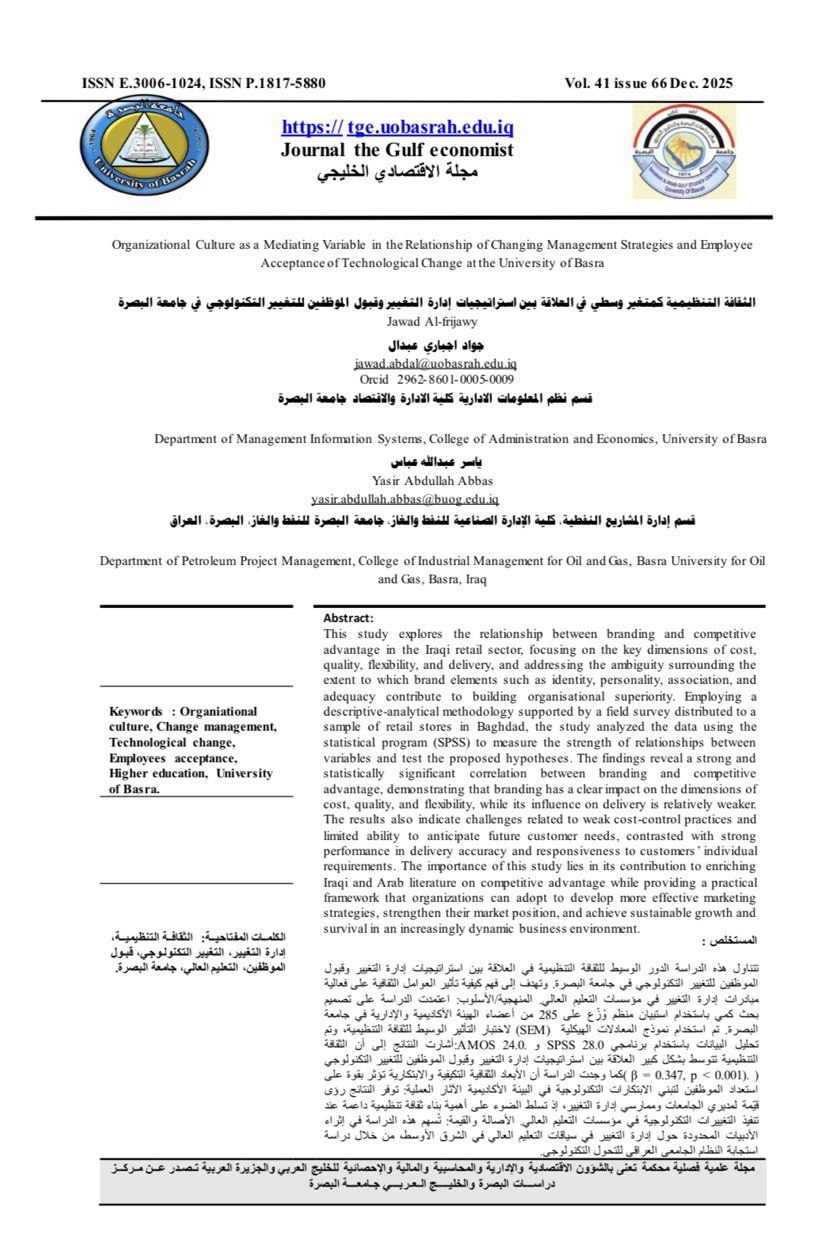
الثقافة التنظيمية كمتغير وسطي في العلاقة بين استراتيجيات إدارة التغيير وقبول الموظفين للتغيير التكنولوجي في جامعة البصرة
الشريط الجانبي للمقالة
محتوى المقالة الرئيسي
الملخص
تتناول هذه الدراسة الدور الوسيط للثقافة التنظيمية في العلاقة بين استراتيجيات إدارة التغيير وقبول الموظفين للتغيير التكنولوجي في جامعة البصرة. وتهدف إلى فهم كيفية تأثير العوامل الثقافية على فعالية مبادرات إدارة التغيير في مؤسسات التعليم العالي. المنهجية/الأسلوب: اعتمدت الدراسة على تصميم بحث كمي باستخدام استبيان منظم وُزِّع على 285 من أعضاء الهيئة الأكاديمية والإدارية في جامعة البصرة. تم استخدام نموذج المعادلات الهيكلية (SEM) لاختبار التأثير الوسيط للثقافة التنظيمية، وتم تحليل البيانات باستخدام برنامجي SPSS 28.0 و AMOS 24.0.:أشارت النتائج إلى أن الثقافة التنظيمية تتوسط بشكل كبير العلاقة بين استراتيجيات إدارة التغيير وقبول الموظفين للتغيير التكنولوجي (β = 0.347, p < 0.001). (كما وجدت الدراسة أن الأبعاد الثقافية التكيفية والابتكارية تؤثر بقوة على استعداد الموظفين لتبني الابتكارات التكنولوجية في البيئة الأكاديمية الآثار العملية: توفر النتائج رؤى قيّمة لمديري الجامعات وممارسي إدارة التغيير، إذ تسلط الضوء على أهمية بناء ثقافة تنظيمية داعمة عند تنفيذ التغييرات التكنولوجية في مؤسسات التعليم العالي. الأصالة والقيمة: تُسهم هذه الدراسة في إثراء الأدبيات المحدودة حول إدارة التغيير في سياقات التعليم العالي في الشرق الأوسط، من خلال دراسة استجابة النظام الجامعي العراقي للتحول التكنولوجي.
تفاصيل المقالة

هذا العمل مرخص بموجب Creative Commons Attribution-ShareAlike 4.0 International License.
تخضع جميع المقالات المنشورة في المجلة لشروط ترخيص المشاع الإبداعي (CC BY 4.0)، والتي تتيح للمستخدمين إعادة استخدام، وتوزيع، ومشاركة العمل بشرط نسب الفضل للمؤلف الأصلي والمجلة بالشكل الصحيح..
المراجع
Ahmed, S. M., Hassan, R., & Al-Mahmoud, F. (2022). Innovation culture and technology acceptance in higher education: A cross-cultural study. Journal of Educational Technology & Society, 25(3), 124-138.
Almaiah, M. A., Al-Khasa wneh, A., & Althunibat, A. (2020). Exploring the critical challenges and factors influencing the E-learning system usage during COVID-19 pandemic. Education and Information Technologies, 25(6), 5261-5280.
Armenakis, A. A., & Harris, S. G. (2021). Change management: A guide for organizational transformation. Sage Publications.
Al-Saadi, H. M., & Mohammed, K. A. (2022). Digital transformation in Iraqi higher education: Challenges and opportunities. International Journal of Educational Management, 36(4), 567-583.
Bergquist, W. H., & Pawlak, K. (2021). Engaging the six cultures of the academy: Revised and expanded edition. Jossey-Bass.
Buller, J. L. (2019). Change leadership in higher education: A practical guide to academic transformation. Jossey-Bass.
Burke, W. W. (2020). Organization change: Theory and practice (6th ed.). Sage Publications.
Cameron, K. S., & Quinn, R. E. (2021). Diagnosing and changing organizational culture: Based on the competing values framework (4th ed.). Jossey-Bass.
Denison, D., Hooijberg, R., Lane, N., & Lief, C. (2020). Leading culture change in global organizations: Aligning culture and strategy. Jossey-Bass.
Eckel, P. D., & Kezar, A. (2022). Understanding institutional transformation in higher education. Research in Higher Education, 63(2), 285-312.
Grajek, S. (2020). Digital transformation in higher education: Lessons learned from the pandemic. EDUCAUSE Review, 55(4), 24-31.
Henderson, M., Selwyn, N., & Aston, R. (2020). What works and why? Student perceptions of 'useful' digital technology in university teaching and learning. Studies in Higher Education, 45(7), 1567-1579.
Kezar, A. (2018). How colleges change: Understanding, leading, and enacting change (2nd ed.). Routledge.
Kotter, J. P., & Cohen, D. S. (2021). The heart of change: Real-life stories of how people change their organizations (2nd ed). Harvard Business Review Press.
Krejcie, R. V., & Morgan, D. W. (1970). Determining sample size for research activities. Educational and Psychological Measurement, 30(3), 607-610.
Nazarian, A., Atkinson, P., & Foroudi, P. (2021). Influence of national culture and balanced organizational culture on the hotel industry's performance. International Journal of Hospitality Management, 63, 22-32.
Salloum, S. A., & Shaalan, K. (2019). Factors affecting students' acceptance of e-learning system in hig.her education using UTAUT and structural equation modeling approaches. Advances in Intelligent Systems and Computing, 845, 469-480.
Schein, E. H., & Schein, P. (2021). Organizational culture and leadership (6th ed.). Jossey-Bass.
Teo, T. (2021). Technology acceptance in education: A systematic review of the literature from 2015 to 2020. Education and Information Technologies, 26(4), 4481- 4499.
Tierney, W. G. (2019). Building communities of difference: Higher education in the twenty-first century. Bergin & Garvey.
Venkatesh, V., Thong, J. Y., & Xu, X. (2022). Unified theory of acceptance and use of technology: A synthesis and the road ahead. Journal of the Association for Information Systems, 23(2), 328-376.