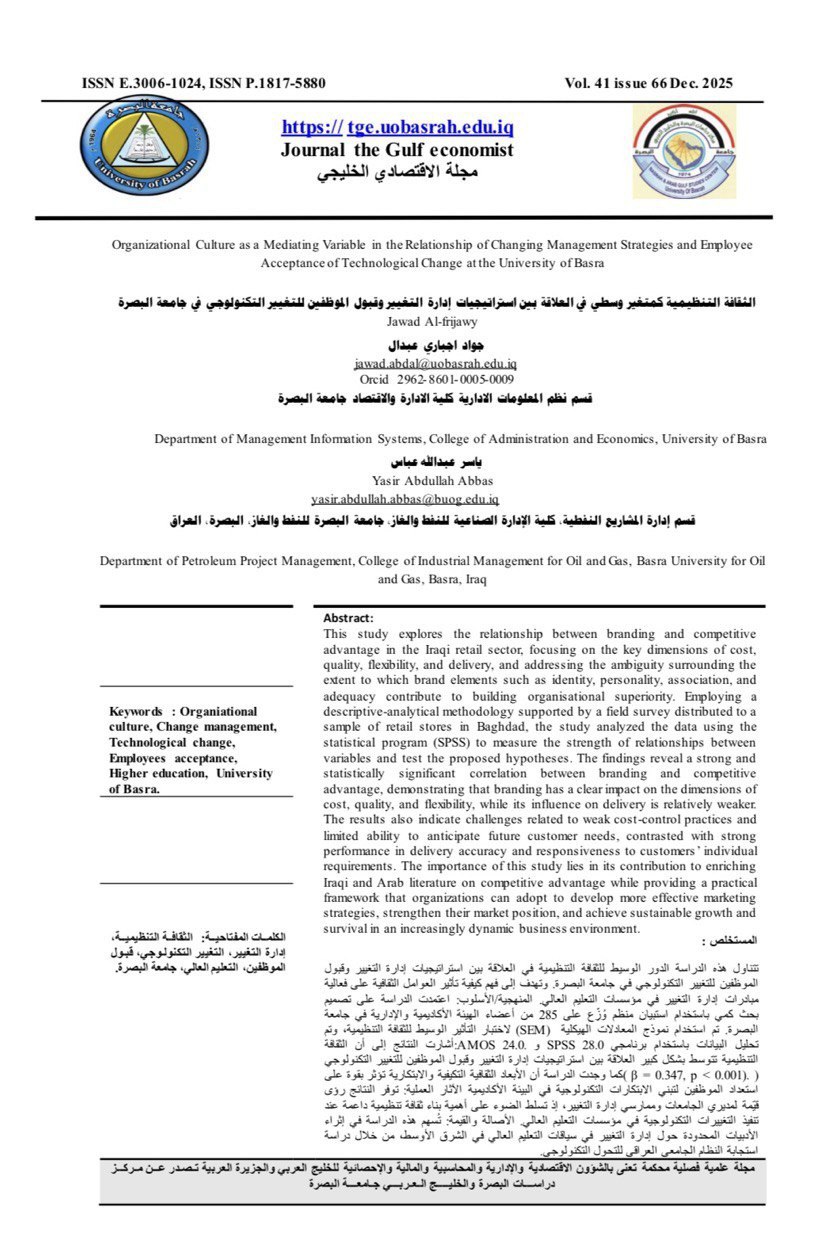
Organizational Culture as a Mediating Variable in the Relationship of Changing Management Strategies and Employee Acceptance of Technological Change at the University of Basra
Article Sidebar
Main Article Content
Abstract
This study explores the relationship between branding and competitive advantage in the Iraqi retail sector, focusing on the key dimensions of cost, quality, flexibility, and delivery, and addressing the ambiguity surrounding the extent to which brand elements such as identity, personality, association, and adequacy contribute to building organisational superiority. Employing a descriptive-analytical methodology supported by a field survey distributed to a sample of retail stores in Baghdad, the study analyzed the data using the statistical program (SPSS) to measure the strength of relationships between variables and test the proposed hypotheses. The findings reveal a strong and statistically significant correlation between branding and competitive advantage, demonstrating that branding has a clear impact on the dimensions of cost, quality, and flexibility, while its influence on delivery is relatively weaker. The results also indicate challenges related to weak cost-control practices and limited ability to anticipate future customer needs, contrasted with strong performance in delivery accuracy and responsiveness to customers’ individual requirements. The importance of this study lies in its contribution to enriching Iraqi and Arab literature on competitive advantage while providing a practical framework that organizations can adopt to develop more effective marketing strategies, strengthen their market position, and achieve sustainable growth and survival in an increasingly dynamic business environment
Article Details

This work is licensed under a Creative Commons Attribution-ShareAlike 4.0 International License.
All articles published in the journal are licensed under the Creative Commons Attribution 4.0 International License (CC BY 4.0), which permits users to reuse, distribute, and share the work, provided that appropriate credit is given to the original author and the journal.
References
Ahmed, S. M., Hassan, R., & Al-Mahmoud, F. (2022). Innovation culture and technology acceptance in higher education: A cross-cultural study. Journal of Educational Technology & Society, 25(3), 124-138.
Almaiah, M. A., Al-Khasa wneh, A., & Althunibat, A. (2020). Exploring the critical challenges and factors influencing the E-learning system usage during COVID-19 pandemic. Education and Information Technologies, 25(6), 5261-5280.
Armenakis, A. A., & Harris, S. G. (2021). Change management: A guide for organizational transformation. Sage Publications.
Al-Saadi, H. M., & Mohammed, K. A. (2022). Digital transformation in Iraqi higher education: Challenges and opportunities. International Journal of Educational Management, 36(4), 567-583.
Bergquist, W. H., & Pawlak, K. (2021). Engaging the six cultures of the academy: Revised and expanded edition. Jossey-Bass.
Buller, J. L. (2019). Change leadership in higher education: A practical guide to academic transformation. Jossey-Bass.
Burke, W. W. (2020). Organization change: Theory and practice (6th ed.). Sage Publications.
Cameron, K. S., & Quinn, R. E. (2021). Diagnosing and changing organizational culture: Based on the competing values framework (4th ed.). Jossey-Bass.
Denison, D., Hooijberg, R., Lane, N., & Lief, C. (2020). Leading culture change in global organizations: Aligning culture and strategy. Jossey-Bass.
Eckel, P. D., & Kezar, A. (2022). Understanding institutional transformation in higher education. Research in Higher Education, 63(2), 285-312.
Grajek, S. (2020). Digital transformation in higher education: Lessons learned from the pandemic. EDUCAUSE Review, 55(4), 24-31.
Henderson, M., Selwyn, N., & Aston, R. (2020). What works and why? Student perceptions of 'useful' digital technology in university teaching and learning. Studies in Higher Education, 45(7), 1567-1579.
Kezar, A. (2018). How colleges change: Understanding, leading, and enacting change (2nd ed.). Routledge.
Kotter, J. P., & Cohen, D. S. (2021). The heart of change: Real-life stories of how people change their organizations (2nd ed). Harvard Business Review Press.
Krejcie, R. V., & Morgan, D. W. (1970). Determining sample size for research activities. Educational and Psychological Measurement, 30(3), 607-610.
Nazarian, A., Atkinson, P., & Foroudi, P. (2021). Influence of national culture and balanced organizational culture on the hotel industry's performance. International Journal of Hospitality Management, 63, 22-32.
Salloum, S. A., & Shaalan, K. (2019). Factors affecting students' acceptance of e-learning system in hig.her education using UTAUT and structural equation modeling approaches. Advances in Intelligent Systems and Computing, 845, 469-480.
Schein, E. H., & Schein, P. (2021). Organizational culture and leadership (6th ed.). Jossey-Bass.
Teo, T. (2021). Technology acceptance in education: A systematic review of the literature from 2015 to 2020. Education and Information Technologies, 26(4), 4481- 4499.
Tierney, W. G. (2019). Building communities of difference: Higher education in the twenty-first century. Bergin & Garvey.
Venkatesh, V., Thong, J. Y., & Xu, X. (2022). Unified theory of acceptance and use of technology: A synthesis and the road ahead. Journal of the Association for Information Systems, 23(2), 328-376.