The impact of e-training programs on improving the administrative performance of middle management in educational institutions: an applied study at the Continuing Education Center at the University of Basra.
Article Sidebar
Main Article Content
Abstract
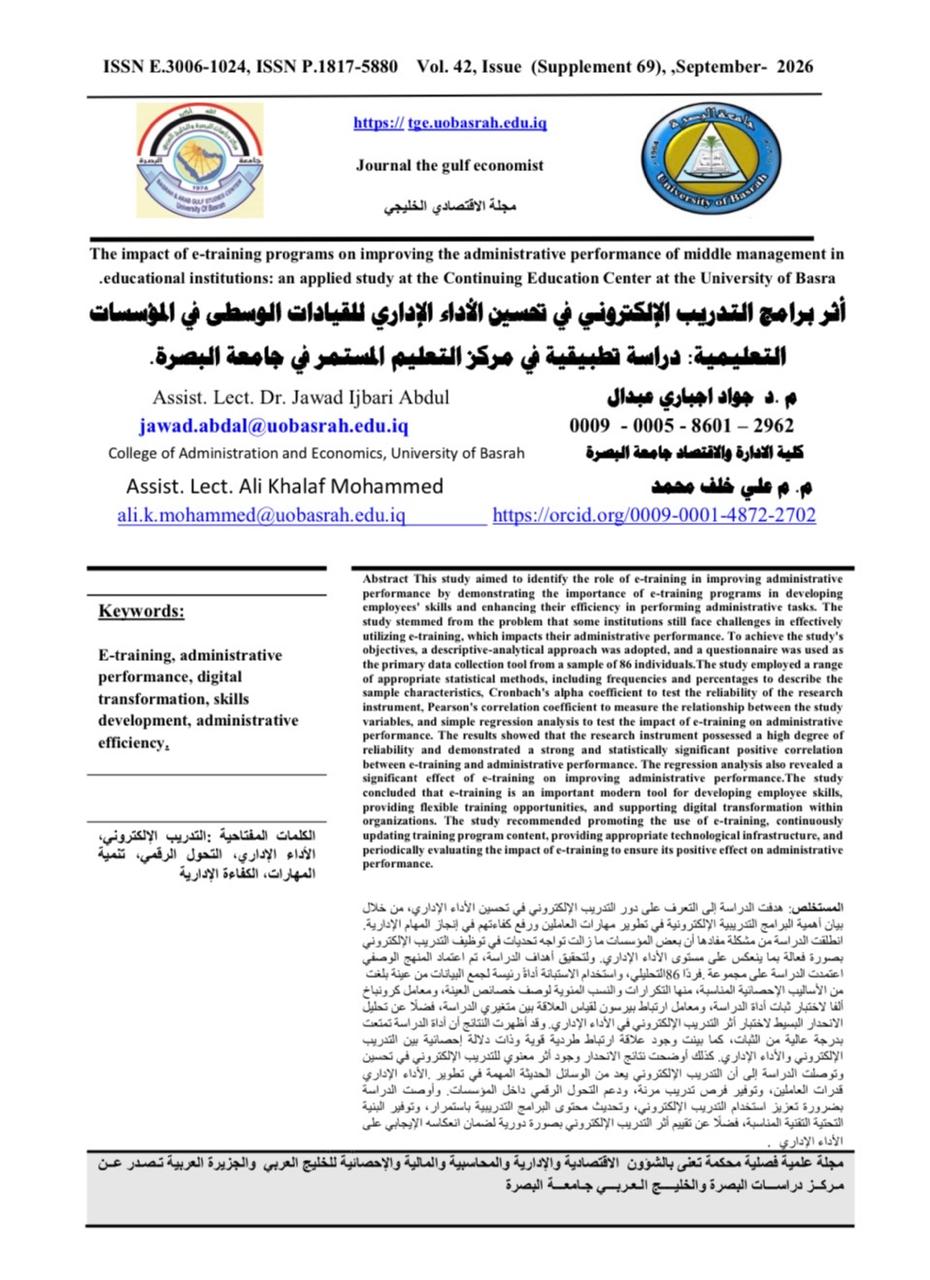
Abstract This study aimed to identify the role of e-training in improving administrative performance by demonstrating the importance of e-training programs in developing employees' skills and enhancing their efficiency in performing administrative tasks. The study stemmed from the problem that some institutions still face challenges in effectively utilizing e-training, which impacts their administrative performance. To achieve the study's objectives, a descriptive-analytical approach was adopted, and a questionnaire was used as the primary data collection tool from a sample of 86 individuals.The study employed a range of appropriate statistical methods, including frequencies and percentages to describe the sample characteristics, Cronbach's alpha coefficient to test the reliability of the research instrument, Pearson's correlation coefficient to measure the relationship between the study variables, and simple regression analysis to test the impact of e-training on administrative performance. The results showed that the research instrument possessed a high degree of reliability and demonstrated a strong and statistically significant positive correlation between e-training and administrative performance. The regression analysis also revealed a significant effect of e-training on improving administrative performance.The study concluded that e-training is an important modern tool for developing employee skills, providing flexible training opportunities, and supporting digital transformation within organizations. The study recommended promoting the use of e-training, continuously updating training program content, providing appropriate technological infrastructure, and periodically evaluating the impact of e-training to ensure its positive effect on administrative performance.
Article Details

This work is licensed under a Creative Commons Attribution-ShareAlike 4.0 International License.
References
References:
Aguinis, H. (2019). Performance management for dummies. Wiley.
Ally, M. (2018). Foundations of educational theory for online learning. In T. Anderson (Ed.), The theory and practice of online learning (3rd ed., pp. 45–74). Athabasca University Press.
Armstrong, M., & Taylor, S. (2023). Armstrong's handbook of human resource management practice. Kogan Page.
Bangur, R. M., & Faiz, M. A. (2024). Assessing the impact of e-training and development on employees’ in-role performance: A study of service sector organizations in the UAE. Journal of Strategic Human Resource Management, 13(1), 22–35.
Bush, T. (2021). Theories of educational leadership and management (5th ed.). Sage.
Clark, R. C., & Mayer, R. E. (2023). E-learning and the science of instruction: Proven guidelines for consumers and designers of multimedia learning (5th ed.). Wiley.
Creswell, J. W., & Creswell, J. D. (2018). Research design: Qualitative, quantitative, and mixed methods approach. Sage.
Daft, R. L. (2022). Management (14th ed.). Cengage Learning.
Dessler, G. (2020). Human resource management (16th ed.). Pearson.
Evans, J. R., & Lindsay, W. M. (2020). Managing for quality and performance excellence (11th ed.). Cengage Learning.
Farouk, D. A. (2022). The impact of e-training system on employees’ job performance. RAIS Conference Proceedings.
Griffin, R. W. (2021). Fundamentals of management (9th ed.). Cengage Learning.
Hrastinski, S. (2021). What do we mean by blended learning? TechTrends, 65(4), 564–569. https://doi.org/10.1007/s11528-020-00575-4
Khalil, M., & Ebner, M. (2022). Learning analytics in educational technology and online learning systems: Current trends and future perspectives. Computers & Education, 182, 104463. https://doi.org/10.1016/j.compedu.2022.104463
Kinicki, A., & Williams, B. (2020). Management: A practical introduction (9th ed.). McGraw-Hill Education.
Lussier, R. N. (2021). Management fundamentals: Concepts, applications, and skill development (8th ed.). Sage.
Martin, F., Sun, T., & Westine, C. D. (2023). A systematic review of research on online teaching and learning from 2019 to 2023. Educational Technology Research and Development, 71(2), 955–987. https://doi.org/10.1007/s11423-023-10189-7
Mullins, L. J. (2022). Management and organizational behavior (13th ed.). Pearson.
Noe, R. A., & Kodwani, A. D. (2018). Employee training and development. McGraw-Hill Education.
Robbins, S. P., & Judge, T. A. (2022). Organizational behavior. Pearson.
Rosenberg, M. J. (2020). E-learning: Strategies for delivering knowledge in the digital age. McGraw-Hill Education.
Salas, E., Tannenbaum, S. I., Kraiger, K., & Smith-Jentsch, K. A. (2012). The science of training and development in organizations: What matters in practice. Psychological Science in the Public Interest, 13(2), 74–101. https://doi.org/10.1177/1529100612436661
Schermerhorn, J. R. (2020). Management (14th ed.). Wiley.
Whetten, D. A., & Cameron, K. S. (2021). Developing management skills (10th ed.). Pearson.